
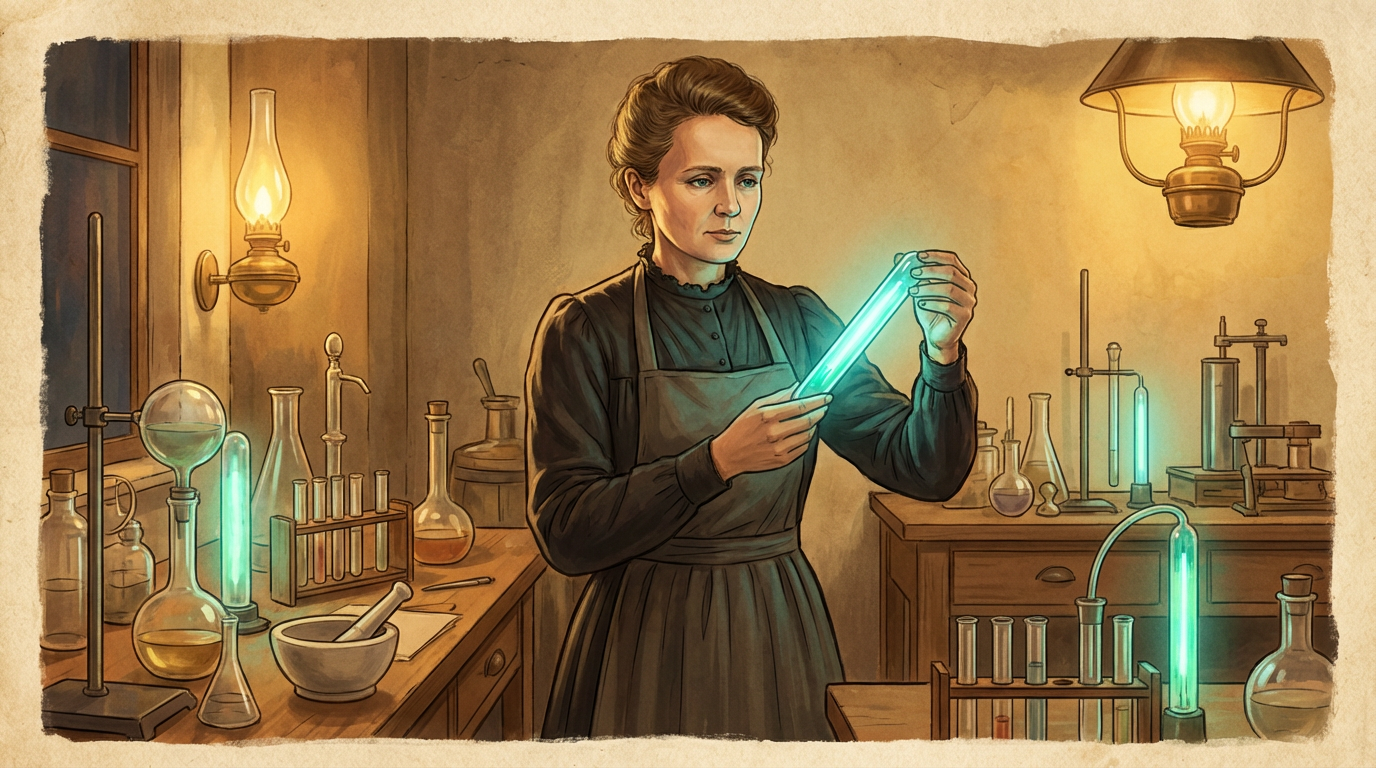
🔬 Marie was a scientist. A real one!
She found something HIDDEN inside rocks. Something nobody knew was there! 🪨
✨ It could GLOW in the dark! How cool is that?
🏥 When soldiers got hurt, Marie drove a special truck to help the doctors see inside their bodies. She helped SO many people!
🏆 Marie won TWO big prizes. That is like getting two gold medals! Nobody else has done what she did.
🌟 Marie showed everyone that girls can be the BEST scientists!
Who Was Marie Curie?
Marie Curie was a scientist who lived a long time ago. She grew up in Poland and loved learning so much that she moved to France to study at a big school.
What Did She Find?
Marie discovered that some rocks send out tiny invisible rays all by themselves. She called this radioactivity. That is when something sends out energy from deep inside its atoms.
How Did It Help People?
During a big war, soldiers got hurt and doctors could not see the broken bones inside them. Marie built special trucks with machines that could take pictures of bones through skin. She drove them to the soldiers herself. She helped save thousands of lives.
Two Big Prizes
Marie won the Nobel Prize two times. She is one of only two people ever to win it in two different types of science.
A Scientist Who Changed the World
Marie Curie was born in Warsaw, Poland in 1867. Back then, women were not allowed to attend university in Poland. So Marie saved money for years and moved to Paris, France, where she enrolled at the Sorbonne university. She was one of very few women studying science there.
Discovering Radioactivity
In 1896, a scientist named Henri Becquerel noticed that uranium (a metal element) could fog up photographic plates even in the dark. Something invisible was coming out of it. Marie decided to study this mystery. She tested every element she could find and discovered that thorium did the same thing. She invented the word "radioactivity" to describe it.
Then she found something strange. A rock called pitchblende was MORE radioactive than pure uranium. That meant something else was hiding inside it, something no one had ever seen. Marie and her husband Pierre spent four years crushing, boiling, and filtering tons of pitchblende. They found two new elements: polonium (named after Poland) and radium (named from the Latin word for "ray" because of the rays it sent out).
Saving Soldiers in World War I
When World War I started in 1914, Marie knew X-rays could help doctors find bullets and broken bones inside wounded soldiers. But the big hospitals were far from the battlefields. So she built mobile X-ray trucks that could drive right to the front lines. Soldiers called them "petites Curies" (little Curies). Marie drove them herself and even taught her 17-year-old daughter Irene to operate them. Together they helped treat over a million soldiers.
Two Nobel Prizes
Marie won her first Nobel Prize in Physics in 1903 (shared with Pierre and Becquerel) for studying radioactivity. She won her second in Chemistry in 1911 for discovering polonium and radium. She is the only person ever to win Nobel Prizes in two different sciences.
Remember when we learned about the periodic table? Polonium (element 84) and radium (element 88) are both on it because of Marie. And every element after bismuth (element 83) is radioactive. Marie helped us understand why.
From Banned Student to Double Nobel Laureate
Maria Sklodowska was born in Warsaw in 1867 under Russian Imperial rule. The Russian authorities banned Polish women from higher education. She attended an illegal underground university called the "Flying University" before saving enough money to move to Paris in 1891. She enrolled at the Sorbonne, earned degrees in both physics and mathematics, and married physicist Pierre Curie in 1895.
What Is Radioactivity?
In 1896, Henri Becquerel discovered that uranium salts emitted penetrating rays without any external energy source. Marie Curie systematically tested every known element and found that thorium also emitted rays. She coined the term "radioactivity" and proposed that the radiation came from within the atom itself. This was radical: at the time, atoms were thought to be indivisible and unchanging.
Finding Hidden Elements
Marie measured radioactivity using a device called an electrometer (built by Pierre). She found that pitchblende ore was four times more radioactive than its uranium content alone could explain. The excess radiation had to come from an unknown element. Over four years in a leaky shed with no ventilation, she and Pierre processed eight metric tons of pitchblende residue.
They isolated two new elements. Polonium (element 84) was announced in July 1898. Radium (element 88) followed in December. To prove radium was a true element, Marie had to isolate enough pure radium chloride to measure its atomic weight: 225.93 (modern value: 226.03). The precision was remarkable given her equipment.
8,000 kg of pitchblende ore → 0.1 g of radium chloride
Concentration: approximately 1 part per 80 million
This is like finding one specific grain of sand in 200 kg of beach sand.
Half-Life: Radioactivity's Clock
Every radioactive element decays at a fixed rate measured by its half-life: the time it takes for half of a sample to decay. Radium-226 has a half-life of 1,600 years. Polonium-210 has a half-life of just 138 days. Uranium-238 has a half-life of 4.5 billion years, roughly the age of Earth. This is why uranium still exists naturally while most polonium does not.
The "Petites Curies"
When World War I began, Marie Curie recognized that portable X-ray units could save lives by helping surgeons locate shrapnel and fractures near the battlefield. She equipped 20 vehicles and 200 fixed installations with X-ray machines. She fundraised for the vehicles, learned to drive, studied anatomy, and trained other women as operators. Her 17-year-old daughter Irene (who later won her own Nobel Prize) ran a radiological unit at a field hospital. The mobile units served over one million wounded soldiers during the war.
The Cost of Discovery
Marie worked with radioactive materials for over 30 years with no protective equipment. She carried test tubes of radium in her pockets and stored them in her desk. Her personal notebooks are still so radioactive that researchers must wear protective clothing to handle them. They are stored in lead-lined boxes at the Bibliotheque nationale de France. Marie died in 1934 of aplastic anemia, almost certainly caused by chronic radiation exposure.
Becquerel's Accident and Curie's Systematic Inquiry
In February 1896, Henri Becquerel left uranium salts on top of unexposed photographic plates in a drawer. When he developed the plates, they showed clear silhouettes of the uranium. The discovery was accidental. What followed was not.
Marie Curie chose Becquerel's "uranic rays" as her doctoral research topic. Using a piezoelectric electrometer (designed by Pierre and his brother Jacques), she measured the ionization current produced by every element and compound available to her. Two findings emerged: thorium emitted rays similar to uranium, and pitchblende ore was far more radioactive than its uranium content could account for.
Her inference was precise: pitchblende contained an undiscovered element present in trace quantities but with extremely high specific activity. This was not a lucky guess. It was a quantitative argument from measured data, and it guided four years of chemical separations.
Isolating Radium: Fractional Crystallization at Industrial Scale
The Curies obtained pitchblende residue (after uranium extraction) from the St. Joachimsthal mine in Bohemia. Marie's separation method relied on fractional crystallization of barium chloride. Radium chloride is slightly less soluble than barium chloride, so repeated dissolution and recrystallization progressively concentrated the radium fraction.
The process required dissolving the ore in acid, precipitating out groups of elements by chemical affinity, and repeating the crystallization thousands of times. From 8 metric tons of pitchblende, she obtained approximately 100 milligrams of radium chloride with sufficient purity to determine its atomic weight spectroscopically.
Nuclear Decay: The Mechanisms
Radioactivity, as we now understand it, arises from nuclear instability. Nuclei with unfavorable proton-to-neutron ratios or excessive mass seek more stable configurations through decay.
In alpha decay, the nucleus ejects a helium-4 nucleus (2 protons, 2 neutrons), reducing its atomic number by 2 and mass number by 4. Radium-226 decays to radon-222 through this process, which is why radon gas accumulates in basements built on granite (which contains trace uranium and radium).
In beta-minus decay, a neutron converts to a proton via the weak nuclear force, emitting an electron and an antineutrino. This changes the element's identity (carbon-14 becomes nitrogen-14) without changing its mass number. Carbon-14 dating relies on this process: living organisms continuously replenish carbon-14 from atmospheric CO₂, but after death, the ratio of C-14 to C-12 decreases with a half-life of 5,730 years.
Gamma decay involves the emission of high-energy photons from an excited nucleus. It typically follows alpha or beta decay as the daughter nucleus transitions to its ground state. Gamma rays are the most penetrating form of nuclear radiation, requiring lead or concrete shielding.
Medical Applications: From Battlefield X-Rays to Nuclear Medicine
Marie Curie's wartime X-ray units were a direct application of Rontgen's 1895 discovery, but her contribution was logistical and organizational rather than purely scientific. She solved the problem of getting existing technology to the point of need.
Modern nuclear medicine descends more directly from her element discoveries. Technetium-99m (the metastable isomer of technetium-99, produced by molybdenum-99 decay) is the most widely used medical radioisotope. Approximately 40 million diagnostic procedures worldwide use Tc-99m annually. Its 6-hour half-life is long enough for imaging but short enough to limit patient exposure. It emits 140 keV gamma rays, ideal for gamma camera detection.
Radiation therapy for cancer uses the same physics Marie Curie observed but with deliberate targeting. Cobalt-60 gamma sources, linear accelerators producing high-energy X-rays, and brachytherapy using implanted radioactive seeds (including radium-226 historically, now replaced by iridium-192 and cesium-137) all exploit the ability of ionizing radiation to damage DNA in rapidly dividing cells.
The Curie Unit and the Radioactive Periodic Table
The curie (Ci) was the original unit of radioactivity, defined as the activity of one gram of radium-226: approximately 3.7 x 10¹⁰ disintegrations per second. The SI system replaced it with the becquerel (Bq), where 1 Bq = 1 disintegration per second. So 1 Ci = 37 GBq. Both units honor the pioneers of radioactivity research.
On the periodic table, every element with atomic number greater than 83 (bismuth) has no stable isotopes. Technetium (Z=43) and promethium (Z=61), both below bismuth, are also exclusively radioactive. The island of stability hypothesis (discussed in our periodic table article) predicts that certain superheavy nuclei near Z=114, N=184 may have unusually long half-lives due to closed nuclear shells, but none have been confirmed as stable.
The Nobel Controversy
The 1903 Nobel Prize in Physics was initially nominated for Pierre Curie and Henri Becquerel only. Swedish mathematician Magnus Goesta Mittag-Leffler warned Pierre, who insisted Marie be included. The committee added her, making her the first woman to receive a Nobel Prize.
Her second Nobel (Chemistry, 1911) was nearly derailed by a press scandal over her relationship with physicist Paul Langevin after Pierre's death in a traffic accident in 1906. The Nobel Committee asked her not to attend the ceremony. She attended anyway and gave her lecture. Her response to the committee: "The prize has been awarded for the discovery of radium and polonium. I believe that there is no connection between my scientific work and the facts of private life."
Legacy in Radiation
Marie Curie's personal effects remain radioactive more than 90 years after her death. Her laboratory notebooks, cookbooks, and even her furniture emit radiation. Visitors to her papers at the Bibliotheque nationale de France must sign a liability waiver and wear protective equipment. The half-life of radium-226 is 1,600 years. Her notes will remain hazardous for centuries.
Her daughter Irene Joliot-Curie and son-in-law Frederic Joliot-Curie won the 1935 Nobel Prize in Chemistry for discovering artificial radioactivity: the ability to make non-radioactive elements radioactive by bombarding them with alpha particles. This work laid the foundation for nuclear reactors and, eventually, nuclear weapons.
The Woman Who Named the Invisible
Maria Sklodowska arrived in Paris in November 1891 with almost nothing. She was 24, spoke limited French, and had spent the previous eight years working as a governess in Poland while attending illegal clandestine lectures at the "Flying University," an underground educational network that defied the Russian Imperial ban on higher education for Poles, particularly women. At the Sorbonne, she lived in a sixth-floor garret so cold that water froze in the washbasin overnight. She ate so little that she occasionally fainted in class. She graduated first in her physics degree in 1893 and second in mathematics in 1894.
She married Pierre Curie in 1895. Their partnership was as scientific as it was personal. Pierre had already done significant work on piezoelectricity and crystal symmetry. Together, they would reshape humanity's understanding of matter.
The Discovery That Atoms Were Not Eternal
Henri Becquerel's 1896 observation of uranium's spontaneous radiation was, in his own estimation, a curiosity. Marie Curie turned it into a revolution. Her systematic survey of every known element using Pierre's piezoelectric electrometer established two critical facts: radioactivity was an atomic property (not a chemical one), and pitchblende contained something far more active than uranium alone.
The conceptual leap was enormous. In the late 1890s, the atom was widely considered indivisible and immutable. Radioactivity implied that atoms could transform, that they contained internal energy, and that elements were not permanent categories. Marie Curie did not fully understand these implications at the time (nuclear physics would not exist for another two decades), but her measurements forced the question onto the table.
The four-year isolation of radium was grueling beyond what modern scientists typically endure. Working in a converted shed at the Ecole de Physique et Chimie, the Curies processed pitchblende residue in 20-kilogram batches. Marie did most of the physical labor: dissolving ore in acid, precipitating and filtering solutions, performing thousands of fractional crystallizations. Pierre focused on measuring the physical properties of the products. Their workspace had no ventilation. Marie later described the shed's leaking roof as occasionally useful because it allowed rain to help cool the vats.
The result: approximately 100 milligrams of radium chloride from 8 metric tons of ore. A concentration of roughly one part per 80 million. Marie's determination of radium's atomic weight (225.93, within 0.05% of the modern value of 226.03) silenced critics who questioned whether radium was a genuine element.
The Nobel Prizes and the Gender Question
The 1903 Nobel Prize in Physics was nearly awarded to Pierre Curie and Henri Becquerel alone. The French Academy of Sciences had nominated only the two men. It was Magnus Goesta Mittag-Leffler, a Swedish mathematician and early advocate for women in science, who alerted Pierre to the omission. Pierre wrote to the committee stating that Marie's contribution was at least equal to his own and that any prize omitting her would be scientifically inaccurate. She was added.
Even so, the award ceremony reflected the era's prejudices. The Nobel announcement and much of the press coverage emphasized Pierre's work. Henri Becquerel's Nobel lecture mentioned the Curies only in passing. Marie did not deliver a Nobel lecture in 1903 (she was ill); when she finally gave one in 1905, she became the first woman to lecture at the Swedish Academy.
The second Nobel (Chemistry, 1911) was more fraught. Pierre had been killed in 1906, run over by a horse-drawn cart on a rainy Paris street. Marie was devastated. She took over his teaching position at the Sorbonne (the first woman to hold a professorship there) and continued her research. In 1910, she began a relationship with physicist Paul Langevin, a former student of Pierre's. Langevin's estranged wife leaked their correspondence to the press. The resulting scandal, inflamed by xenophobia (Marie was Polish) and misogyny, dominated French newspapers for months. Several Nobel Committee members urged her not to come to Stockholm. Her reply was definitive: the prize recognized scientific work, and her scientific work was independent of her personal life. She went.
The Wartime Radiological Corps
When World War I began in August 1914, Marie Curie did not retreat to a laboratory. She recognized immediately that portable X-ray equipment could save lives by allowing surgeons to locate bullets, shrapnel, and fractures before operating. Field surgeons were performing exploratory surgery blind, causing unnecessary tissue damage and infections.
Marie personally organized the effort. She obtained vehicles (including her own car), installed X-ray equipment powered by dynamos connected to the car engines, and created a fleet of 20 mobile radiological units. She also established 200 fixed radiological installations at field hospitals. She learned to drive, studied anatomy to better assist surgeons, and trained a corps of 150 women as X-ray operators. Her daughter Irene, then 17, ran a radiological station at a Belgian field hospital.
The mobile units (nicknamed "petites Curies") served over one million wounded soldiers during the war. Marie's postwar account of this work, Radiology in War (1919), is a remarkable document: part technical manual, part memoir, part quiet fury at the bureaucratic obstacles she faced as a woman trying to contribute to the war effort.
The Radioactive Periodic Table
Marie Curie added two elements to the periodic table: polonium (Z=84) and radium (Z=88). Both are exclusively radioactive, meaning they have no stable isotopes. In fact, every element above bismuth (Z=83) is radioactive, and two lighter elements, technetium (Z=43) and promethium (Z=61), also have no stable isotopes.
Radioactivity is not an anomaly on the periodic table. It is the norm for heavy elements. Of the 118 confirmed elements, only 80 have at least one stable isotope. The remaining 38 are exclusively radioactive. The stability boundary is set by the strong nuclear force and the electromagnetic repulsion between protons: above a certain atomic number, no arrangement of protons and neutrons can produce a configuration that lasts indefinitely.
The "island of stability" hypothesis, first proposed by Glenn Seaborg in the 1960s, predicts that certain superheavy nuclei near proton number 114 and neutron number 184 may have closed nuclear shells analogous to the noble gas electron configurations, potentially yielding half-lives of millions of years. Current evidence from flerovium (Z=114) and oganesson (Z=118) synthesis suggests enhanced stability relative to neighboring nuclei, but no island element has been observed with a half-life exceeding seconds. The instruments Marie Curie built to measure radioactivity have been refined by a factor of billions, but the fundamental measurement, counting decays over time, remains the same.
Modern Nuclear Medicine: Marie's Indirect Legacy
Today's nuclear medicine uses radioactive isotopes in ways Marie would have understood conceptually but not predicted. Technetium-99m, the workhorse of diagnostic nuclear medicine, was not discovered until 1938 (by Emilio Segre and Glenn Seaborg). Approximately 40 million medical imaging procedures per year worldwide use Tc-99m for cardiac perfusion scans, bone scans, and cancer staging. Its 6.01-hour half-life is almost perfectly calibrated for diagnostic imaging: long enough to complete a scan, short enough to minimize patient radiation dose.
Positron emission tomography (PET) uses fluorine-18 labeled glucose (FDG) to image metabolic activity. Cancer cells consume glucose at elevated rates, making them visible as bright spots on PET scans. Proton beam therapy and carbon ion therapy represent the current frontier: heavy charged particles that deposit their energy at a precise depth (the Bragg peak), sparing tissue beyond the tumor.
Radiation therapy kills approximately 50% of all cancers treated with curative intent, either alone or in combination with surgery and chemotherapy. Marie Curie did not foresee these applications. But every one of them depends on the phenomenon she named, measured, and stubbornly refused to let the scientific establishment ignore.
The Notebooks That Still Glow
Marie Curie died on July 4, 1934, of aplastic anemia. The disease was almost certainly caused by decades of radiation exposure. She carried radium vials in her pockets, stored them in her desk drawer, and described the blue glow of radium salts in the dark laboratory as "beautiful." She had no way to know the danger. The link between radiation and cancer was not established until the 1920s, and even then, understanding of dose-response relationships was primitive.
Her personal possessions, including laboratory notebooks, a cookbook, and furniture from her apartment, remain contaminated with radium-226 (half-life: 1,600 years). The notebooks are preserved at the Bibliotheque nationale de France in lead-lined boxes. Researchers who wish to consult them must sign a liability disclaimer and wear protective equipment. The contamination will persist for approximately 16,000 years (ten half-lives).
In 1995, Marie and Pierre Curie's remains were transferred to the Pantheon in Paris. She was the first woman interred there on her own merit. Her coffin was lined with an inch of lead.
Sources: Nobel Foundation archives; Pierre Curie's 1903 Nobel nomination letter; Marie Curie, Radiology in War (1919); Naomi Pasachoff, Marie Curie and the Science of Radioactivity (1996); Denis Brian, The Curies: A Biography of the Most Controversial Family in Science (2005); IAEA Technical Reports on Tc-99m production; Emilio Segre, A Mind Always in Motion (1993); Lauren Redniss, Radioactive: Marie and Pierre Curie, a Tale of Love and Fallout (2010).