
Everything around you is made of tiny, tiny pieces! 🧩
🪨💧🌬️
Rocks! Water! Air! Even YOU!
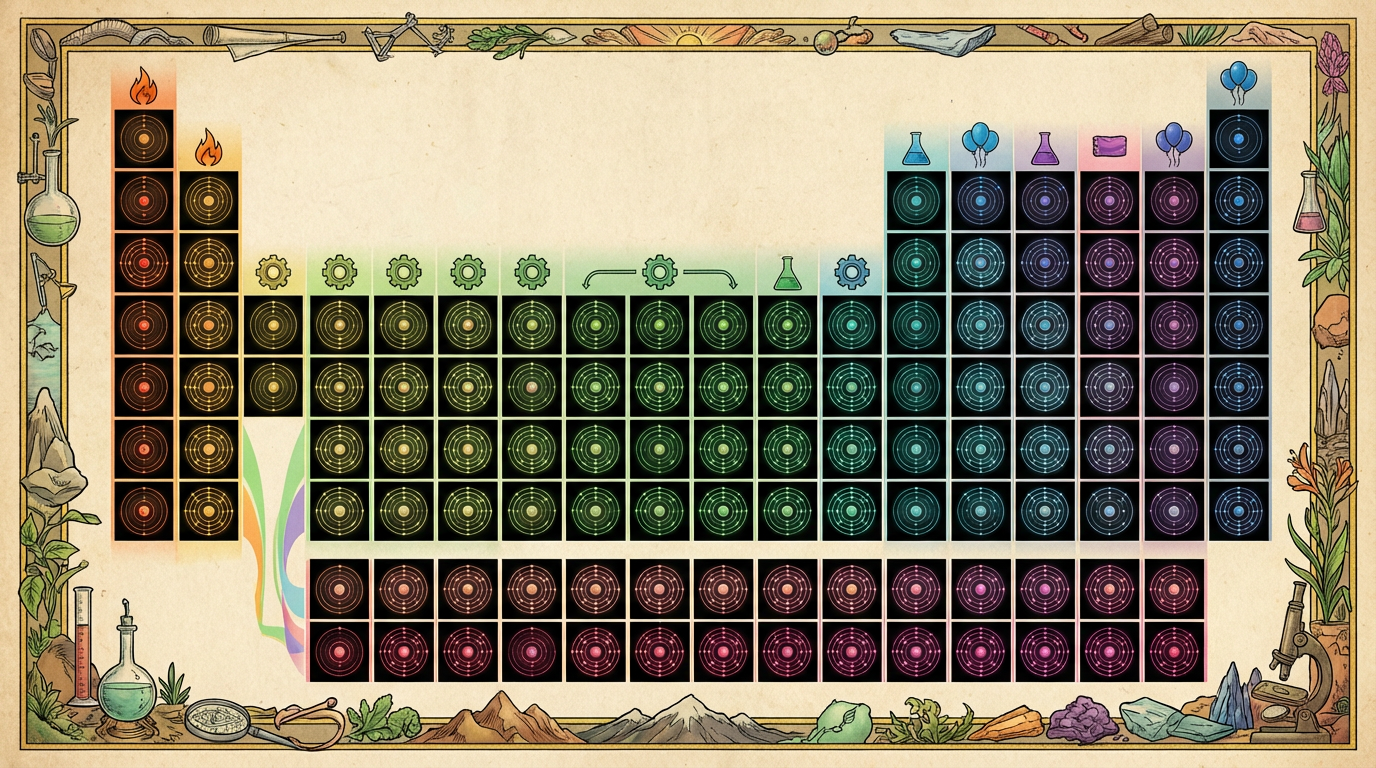
A really smart man put ALL the pieces on a big chart. Like a giant puzzle! 🧩
📋✨
And then a funny man sat at a piano and sang ALL the names SO SO fast! 🎹
🎶😂🎶
He sang so fast, nobody could keep up! It was silly and amazing!
Our pal helium is on the chart. Number 2! 🎈 Helium makes balloons float up, up, up!
🎈⬆️🎈
What Is Everything Made Of?
Look at a glass of water. A metal spoon. The air you breathe. They look different, but they are made of the same tiny building blocks called elements.
How Many Are There?
Scientists know 118 elements. Some are gases, like oxygen and our buddy helium. Some are shiny metals, like gold. Some are soft, like the carbon in your pencil. And your body? Mostly just four of them!
Who Put Them on a Chart?
A scientist named Mendeleev noticed elements followed a pattern. He put them in a big chart with rows and columns. He left empty spaces for missing ones. He was right! Scientists found them later.
What About the Song?
In 1959, a funny piano player named Tom Lehrer sang all the element names as fast as he could. The song is silly and hard to follow, but people loved it. Kids still try to learn it today!
The Building Blocks of Everything
Imagine a box of LEGO bricks. With just a few types, you can build a house, a car, or a spaceship. Elements work the same way. There are 118 known elements, and everything in the universe is made from combinations of them. Water is two hydrogen atoms stuck to one oxygen atom. Table salt is sodium and chlorine locked together.
The Big Chart
In 1869, a Russian chemistry professor named Dmitri Mendeleev was writing a textbook. He had cards with information about each element, and he noticed: when he arranged them by weight, a pattern repeated. Light metals, then heavier ones, then gases, then it started over.
He laid out elements in rows and columns. Elements in the same column shared similar properties. Lithium, sodium, and potassium all reacted wildly with water. The pattern kept working.
The Song That Stuck
In 1959, a mathematician and comedian named Tom Lehrer sang all 102 known element names to a very fast tune from an old opera called The Pirates of Penzance. He rattles off names like "antimony, arsenic, aluminum, selenium" at tongue-twisting speed.
The song was meant as a joke, but it became one of the most famous science songs ever. The actor Daniel Radcliffe (Harry Potter) performed it on TV from memory.
Our Friend Helium
Helium sits in the top right corner of the periodic table as element number 2. It belongs to the "noble gases," a group that almost never reacts with anything. That is why helium is safe for balloons: it will not catch fire or explode. It just floats.
118 Elements, One Chart
Every substance you have ever touched, smelled, tasted, or breathed is made of elements from the periodic table. Water is H₂O (hydrogen and oxygen). The steel in a bridge is mostly iron with a small percentage of carbon. The screen you are reading this on contains silicon, indium, tin, and dozens of other elements in precise arrangements.
The periodic table organizes all 118 confirmed elements by atomic number (the number of protons in the nucleus) in a grid of 7 rows (periods) and 18 columns (groups). Elements in the same group share chemical properties because they have the same number of electrons in their outermost shell.
Mendeleev's Gamble
In 1869, Dmitri Mendeleev arranged 63 known elements by atomic weight and noticed recurring chemical similarities. His stroke of genius was not just describing the pattern but trusting it enough to predict the future. He left gaps in his table for elements that had not been discovered and published detailed predictions about their properties.
For the gap below aluminum, he predicted an element he called "eka-aluminum." He said it would have a density of about 5.9 g/cm³, a low melting point, and form an oxide with the formula El₂O₃. When Paul Emile Lecoq de Boisbaudran discovered gallium in 1875, its density was 5.91 g/cm³, it melted in your hand, and its oxide was Ga₂O₃. The match was almost eerie.
Eka-aluminum → Gallium (1875): predicted density 5.9, actual 5.91 g/cm³
Eka-boron → Scandium (1879): predicted atomic weight 44, actual 44.96
Eka-silicon → Germanium (1886): predicted density 5.5, actual 5.32 g/cm³
What Mendeleev Got Wrong
Mendeleev organized elements by atomic weight, but this caused problems. Tellurium (atomic weight 127.6) should have come after iodine (126.9), but that would put both in the wrong columns based on their chemistry. Mendeleev reversed them and said the atomic weights must be wrong. He was right about the placement but wrong about the reason. The real organizing principle turned out to be atomic number (proton count), not weight. That discovery came 44 years later.
Tom Lehrer's Sonic Periodic Table
Tom Lehrer earned his BA in mathematics from Harvard at age 18 and his MA at 19. While teaching math, he moonlighted as a satirical songwriter, recording albums in the 1950s and 1960s that sold hundreds of thousands of copies.
"The Elements" appeared on his 1959 album An Evening Wasted with Tom Lehrer. He set all 102 known element names to the tune of the "Major-General's Song" from Gilbert and Sullivan's The Pirates of Penzance, itself a famous patter song designed for rapid-fire delivery. Lehrer also took inspiration from Ira Gershwin's "Tchaikovsky (and Other Russians)," which listed 50 Russian composers in a similar burst.
The song has outlived most of Lehrer's other work. Updated versions now include all 118 confirmed elements, with names like flerovium, livermorium, tennessine, and oganesson squeezed into the original melody. Lehrer himself never updated it. He passed away in July 2025 at age 97.
From Weight to Number: How the Table Found Its Logic
Mendeleev's 1869 periodic table organized elements by atomic weight, and it mostly worked. But "mostly" is a problem in science. The tellurium-iodine reversal was the most famous exception: tellurium (atomic weight 127.6) had to be placed before iodine (126.9) to maintain chemical consistency. Cobalt and nickel had the same issue. Mendeleev's table was empirically useful but lacked a physical explanation for why the pattern existed.
The explanation arrived in 1913. Henry Moseley, a 25-year-old physicist working in Ernest Rutherford's Manchester lab, measured the frequencies of characteristic X-rays emitted by different elements. He found that the square root of the X-ray frequency increased by a constant amount for each successive element.
Where ν is the X-ray frequency, Z is the atomic number (proton count), and a and b are constants specific to the spectral series. This was Moseley's Law: a direct, measurable relationship between X-ray spectra and atomic number. It proved that elements should be ordered by proton count, not mass, resolving every anomaly in Mendeleev's table at once.
Moseley was killed by a sniper at Gallipoli in 1915 at age 27. Many historians of science consider his early death one of the great losses of the First World War. Isaac Asimov wrote that his death was "the single most costly death of the war to mankind generally."
Electron Configuration and Periodic Trends
The modern periodic table encodes electron configuration. Each period corresponds to the filling of a new principal energy level. Group 1 elements have one electron in their outermost s orbital. Group 17 elements have seven electrons in their outer shell (ns²np⁵). Group 18 noble gases have full outer shells.
This structure produces measurable trends across the table:
Ionization energy generally increases left to right across a period (electrons are harder to remove as nuclear charge increases) and decreases top to bottom (outer electrons are farther from the nucleus). Fluorine's first ionization energy is 1,681 kJ/mol. Cesium's is 376 kJ/mol.
Electronegativity follows the same pattern. Fluorine (3.98 on the Pauling scale) is the most electronegative element. Cesium and francium (0.7) are the least. This gradient drives the character of chemical bonds: large electronegativity differences produce ionic bonds, small differences produce covalent bonds.
Atomic radius trends inversely: it decreases left to right (more protons pulling the electron cloud inward) and increases top to bottom (more electron shells). These trends are not arbitrary facts to memorize. They are consequences of a single underlying variable: the balance between nuclear charge and electron shielding.
The Song as a Memory Palace
Tom Lehrer's "The Elements" exploits a well-documented cognitive phenomenon: musical encoding aids recall. The melody of the "Major-General's Song" provides rhythmic and tonal scaffolding that makes sequential recall easier than rote repetition. This is why people who cannot recite the elements alphabetically can often sing them in Lehrer's order.
Lehrer's version contained 102 elements (up to nobelium, named in 1958). Since then, 16 more have been confirmed and named, the most recent being oganesson (Z=118), officially named in 2016 after Yuri Oganessian, who led the team at Russia's Joint Institute for Nuclear Research. Updated versions of the song, including one by Tom Lehrer fan site contributors and another by science communicator ASAPScience, incorporate all 118 names.
Daniel Radcliffe performed the original 102-element version on The Graham Norton Show in 2010, delivering it flawlessly and demonstrating that the song retains cultural currency more than 50 years after its composition.
Superheavy Elements and the Island of Stability
Elements beyond uranium (Z=92) do not occur naturally in significant quantities. They are synthesized by firing beams of lighter nuclei at heavy targets in particle accelerators. Oganesson (Z=118) was first produced in 2002 by bombarding californium-249 with calcium-48 ions. Only five atoms were confirmed.
Nuclear physicists predict an "island of stability" near Z=114 and Z=126, where certain combinations of protons and neutrons (corresponding to "magic numbers" in the nuclear shell model) would produce superheavy isotopes with half-lives of minutes, hours, or potentially longer, rather than the millisecond half-lives of elements like oganesson. If such isotopes are confirmed, they would extend the periodic table and potentially create elements with entirely new chemical properties.
The periodic table, in other words, may not be finished.
The Most Successful Infographic in History
The periodic table is, at its core, a data visualization. It compresses the chemical behavior of 118 confirmed elements into a two-dimensional grid where position predicts properties. No other scientific diagram has been as widely reproduced, as culturally persistent, or as practically useful. Every chemistry lab in the world has one on the wall. Most of them look essentially identical to Mendeleev's 1869 version, which is remarkable given how much chemistry has changed since then.
The Priority Question: Mendeleev vs. Meyer
The standard narrative gives Dmitri Mendeleev sole credit for the periodic table. The reality is messier. Lothar Meyer, a German chemist, published a table of 28 elements organized by valence in 1864, five years before Mendeleev's famous 1869 paper. Meyer's table was less complete but demonstrated the same core insight: elements arranged by atomic weight show periodically recurring properties.
Meyer published a more comprehensive version in 1870, essentially simultaneously with Mendeleev. Both tables were strikingly similar. The Royal Society of London awarded them both the Davy Medal in 1882, acknowledging independent co-discovery.
So why does Mendeleev get the textbook credit? Two reasons. First, Mendeleev was bolder. Where Meyer noted the periodicity and stopped, Mendeleev used it to predict the existence and properties of undiscovered elements. His predictions for gallium (eka-aluminum, 1875), scandium (eka-boron, 1879), and germanium (eka-silicon, 1886) were confirmed with startling accuracy. Prediction is the strongest form of scientific validation.
Second, Mendeleev was a better self-promoter. He published aggressively, gave public lectures, and made sure his name was attached to the discovery. Meyer, by contrast, was modest to a fault and died in 1895 without ever publicly contesting Mendeleev's priority. Science historian Eric Scerri has argued that Meyer deserves equal or even greater credit for the depth of his theoretical understanding, even if his practical application was less dramatic.
Moseley's Correction
Mendeleev ordered elements by atomic weight, which is the mass of the atom (protons plus neutrons). This usually correlates with atomic number (proton count alone), but not always. Tellurium (Z=52, weight 127.6) is heavier than iodine (Z=53, weight 126.9), which means ordering by weight puts them in the wrong columns.
Henry Moseley resolved this in 1913 by measuring characteristic X-ray frequencies of different elements and showing that √ν = a(Z - b), where Z is the atomic number. This relationship was monotonic: every element produced a unique frequency, and the frequencies increased in strict order of proton count. Moseley's law proved that the periodic table should be organized by atomic number, not atomic weight, and resolved every reversal anomaly simultaneously.
Moseley was 25 when he published this work. He was killed by a Turkish sniper at Gallipoli in 1915, at 27. The British government subsequently implemented policies to prevent prominent scientists from serving in combat roles. Isaac Asimov called Moseley's death "the single most costly death of the war to mankind generally." Robert Millikan believed Moseley would have earned a Nobel Prize had he lived. The Nobel is not awarded posthumously.
Tom Lehrer: The Mathematician Who Memorized Chemistry
Tom Lehrer was born in 1928 in New York City. He entered Harvard at 15, earned his BA in mathematics at 18, and his MA at 19. He started a PhD in math but kept getting distracted by writing satirical songs. He eventually completed coursework for a PhD but never finished the dissertation, a fact he joked about for decades ("In my day you didn't get a PhD by going to school, you went to school to avoid getting a PhD").
Lehrer self-published his first album in 1953 by mail order. It sold over 350,000 copies without any commercial distribution, making it one of the most successful independent records of the 1950s. His songs covered nuclear proliferation ("We Will All Go Together When We Go"), plagiarism ("Lobachevsky"), and the Americanization of foreign cultures ("In Old Mexico"). His style was sardonic, literate, and played at blazing speed on piano.
"The Elements" appeared on An Evening Wasted with Tom Lehrer in 1959. The premise was simple: list all 102 known elements, set to the melody of Gilbert and Sullivan's "Major-General's Song" from The Pirates of Penzance (itself a patter song designed for comedic speed). Lehrer acknowledged the influence of Ira Gershwin's "Tchaikovsky (and Other Russians)," a 1941 song from the musical Lady in the Dark that listed 50 Russian composers in rapid succession.
Lehrer performed the song live throughout the 1960s, occasionally adding asides about newly discovered elements. In a 1967 performance, he noted, "There are now 103 elements, but one of them was discovered after I wrote this song, so I couldn't include it." He never updated the lyrics. He retired from performing in 1972, taught mathematics and musical theater at UC Santa Cruz for decades, and in 2020 released all his lyrics into the public domain. He died in July 2025 at age 97.
The Afterlife of the Song
The song's cultural persistence is remarkable. Daniel Radcliffe performed it from memory on The Graham Norton Show in 2010. The YouTube channel ASAPScience created an updated version with all 118 elements in 2018. Countless chemistry teachers use it as a mnemonic device.
The cognitive mechanism is well-studied: musical encoding provides temporal and melodic scaffolding that aids sequential recall. The brain processes music and language in overlapping but distinct networks. When information is paired with a familiar melody, it gains access to musical memory structures that are more resistant to decay than semantic memory alone. This is why Alzheimer's patients who cannot remember their children's names can still sing songs from their childhood.
Superheavy Elements and the Edge of the Table
The periodic table now contains 118 confirmed elements, with oganesson (Og, Z=118) being the heaviest. It was first synthesized in 2002 at the Joint Institute for Nuclear Research (JINR) in Dubna, Russia, by a team led by Yuri Oganessian. Only five atoms were observed. Each existed for less than a millisecond before undergoing alpha decay.
Oganesson is nominally a noble gas (Group 18), but theoretical calculations suggest it would not behave like one. At Z=118, relativistic effects on the electron cloud become significant: inner electrons moving at a substantial fraction of the speed of light cause outer electron orbitals to contract and destabilize. Oganesson's electron cloud may not form a traditional shell structure at all. Some computational chemists have suggested it might be a solid at room temperature rather than a gas, which would make it the only "noble gas" that is not actually gaseous.
Nuclear physicists have long predicted an "island of stability" around Z=114 (flerovium) and N=184, where certain combinations of protons and neutrons correspond to closed nuclear shells ("magic numbers" in the nuclear shell model). Isotopes near these magic numbers should have dramatically longer half-lives. Flerovium-298 (Z=114, N=184) is a prime candidate. If the island is real, it could contain elements stable enough to study their chemistry, rather than just confirming their fleeting existence.
Whether the periodic table extends to Z=120, Z=130, or beyond depends on whether nuclei that heavy can be synthesized and detected. The table is not finished. Mendeleev left gaps for elements he predicted would exist. Some of those gaps may still be open.
Sources
- Mendeleev, D. "The Relation Between the Properties and Atomic Weights of the Elements." Journal of the Russian Chemical Society, 1869.
- Meyer, L. Die modernen Theorien der Chemie. 1864.
- Moseley, H. "The High-Frequency Spectra of the Elements." Philosophical Magazine, 1913.
- Scerri, E. The Periodic Table: Its Story and Its Significance. Oxford University Press, 2007.
- Oganessian, Y. et al. "Synthesis of the Isotopes of Elements 118 and 116." Physical Review C, 2006.
- Lehrer, T. An Evening Wasted with Tom Lehrer. 1959.
- Conrad, K. "The Elements, Updated." University of Connecticut Mathematics Department.
- NIST. "Henry Moseley and the Periodic Table of Elements." 2024.
- Asimov, I. Asimov's Biographical Encyclopedia of Science and Technology. Doubleday, 1982.
- The New York Times. "Tom Lehrer Obituary." July 2025.