
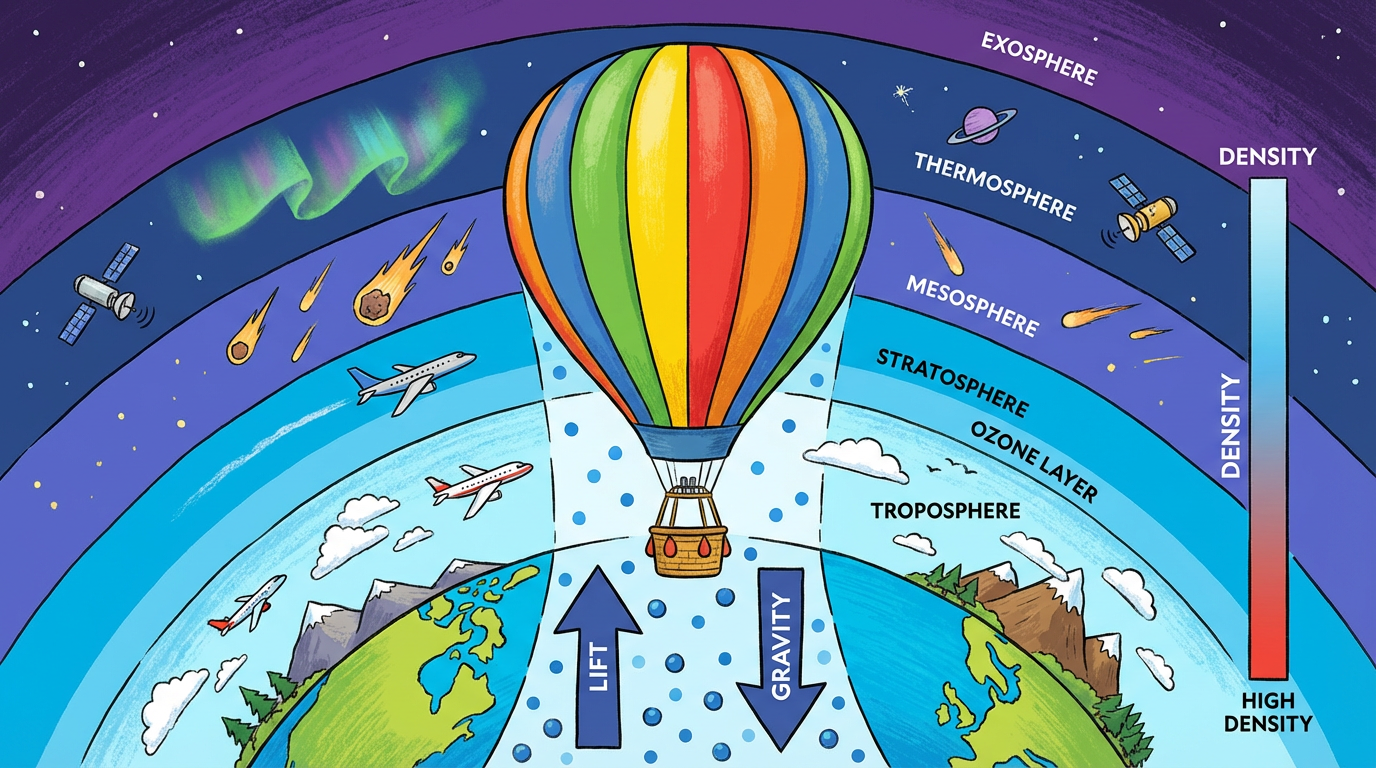
Some balloons go UP UP UP! 🎈
🎈⬆️🎈
They have a special thing inside called helium. Helium is super, super light!
It is lighter than the air all around you. Way lighter!
🎈☁️🎈
So the balloon floats up, up, up! Like a bubble in water! 🫧
But if you blow up a balloon with YOUR mouth? It falls DOWN! Bonk! 😄
😮💨🎈⬇️
That is because your breath is heavier than helium.
Helium makes balloons FLY! Your breath does not. And that is why some balloons float! 🎉
🎈✨🎈
What Makes Some Balloons Float?
Have you ever held a balloon on a string and let it go? It flies up to the sky! But when you blow up a balloon with your mouth, it falls to the ground. Why?
The Secret: Helium
Floating balloons have a gas called helium inside them. Helium is one of the lightest things in the whole world. It is much lighter than the air we breathe.
Think of it like this: if you put a grape in a glass of water, the grape sinks. But a small piece of wood floats. The wood is lighter than water, so it goes up. Helium is lighter than air, so it goes up too!
Why Don't All Balloons Float?
When you blow up a balloon with your mouth, you fill it with the air from your lungs. That air is about the same weight as the air outside. So it does not float. You need helium to make it fly!
Where Does Helium Come From?
Helium comes from under the ground. People find it near natural gas. On the periodic table, helium is number 2. Its symbol is He. Scientists think most helium in the universe was made right after the Big Bang!
The Floating Mystery
At a birthday party, someone hands you a balloon on a string. You let go. It sails straight up and bonks the ceiling. Later, you blow up a different balloon with your own breath. You let that one go too. It drops to the floor like a rock. Same balloon shape. Same rubber. Completely different behavior. What is going on?
Density: The Key Idea
Everything around you is made of tiny particles. In some things, the particles are packed close together. Those things are dense and heavy. In other things, the particles are spread far apart. Those things are light.
The air in your room is a mix of gases, mostly nitrogen and oxygen. These gases have a certain density. Helium gas has a density about 7 times lower than regular air. So a balloon full of helium is much lighter than the same balloon full of air.
Buoyancy: Why Light Things Rise
There is a rule in science called buoyancy. It says that lighter things float in heavier things. A wooden block floats in water because wood is less dense than water. The water pushes the wood up.
The same thing happens with helium and air. The heavier air pushes the lighter helium balloon upward. Scientists call this the buoyant force. It was first explained by a Greek thinker named Archimedes over 2,000 years ago.
Why Your Breath Doesn't Work
When you blow up a balloon with your lungs, you fill it with a mix of nitrogen, oxygen, and carbon dioxide. This mix weighs about the same as the air outside the balloon. There is no density difference, so there is no buoyant force pushing it up. Plus, the rubber of the balloon adds a little extra weight. So the balloon sinks.
Why Balloons Eventually Come Down
Even helium balloons do not float forever. Helium atoms are incredibly small. They slowly squeeze through tiny holes in the rubber that are too small to see. Over several hours, enough helium escapes that the balloon gets heavier than air and sinks. That is why your birthday balloon is on the floor the next morning.
Two Balloons, Two Outcomes
You have two identical balloons. One is filled with helium from a tank. The other you inflate with your lungs. The helium balloon rises to the ceiling. The breath balloon drops. The difference comes down to one concept: density, and how it creates a force called buoyancy.
Density and Buoyant Force
Density measures how much mass is packed into a given volume. Air at sea level has a density of about 1.225 kg/m³. Helium, under the same conditions, has a density of just 0.164 kg/m³. That means air is roughly 7.5 times denser than helium.
When a helium balloon displaces a volume of air, the air it pushes aside weighs more than the helium inside the balloon. The difference in weight creates a net upward force. This is the same reason a beach ball pops to the surface when you push it underwater: the water displaced weighs more than the ball.
Why Your Breath Doesn't Float
The air you exhale is roughly 78% nitrogen, 16% oxygen, and 4% carbon dioxide (plus water vapor). This mixture has a density very close to the surrounding air, about 1.2 kg/m³. There is almost no density difference, so there is almost no buoyant force. The mass of the rubber envelope tips the balance negative, and the balloon falls.
Weight of air displaced: 14.3 L × 1.225 g/L = 17.5 g
Weight of helium inside: 14.3 L × 0.164 g/L = 2.3 g
Weight of latex envelope: ~1.4 g
Net lift: 17.5 - 2.3 - 1.4 = 13.8 g of upward force
That is enough to lift about 10 cm of ribbon.
Molecular Speed and Escape
Helium atoms are extremely small, with a radius of about 31 picometers (a picometer is one trillionth of a meter). Latex rubber looks solid to our eyes, but at the molecular level it has gaps in its polymer structure. Helium atoms are small enough and fast enough to diffuse through these gaps over time. A standard latex balloon loses roughly 1-2% of its helium per hour, which is why it deflates within a day.
Mylar (foil) balloons last much longer because the metallic layer creates a far tighter barrier. Their helium retention is measured in days rather than hours.
Why Not Hydrogen?
Hydrogen (H₂) is even lighter than helium, with a density of 0.082 kg/m³. It would provide about 8% more lift. However, hydrogen is flammable in air at concentrations between 4% and 75%. The Hindenburg disaster of 1937 demonstrated what happens when a large volume of hydrogen ignites. Modern party balloons use helium exclusively because the small lift advantage of hydrogen is not worth the fire risk.
Where Does Helium Come From?
Unlike most elements on Earth, helium is not recycled. It forms underground through the radioactive decay of uranium and thorium in Earth's crust. The alpha particles emitted during decay are helium nuclei. This helium accumulates in natural gas reservoirs over millions of years. Once released into the atmosphere, helium atoms are light enough and fast enough to eventually escape Earth's gravity entirely. Helium is, on human timescales, a non-renewable resource.
A Buoyancy Problem in Disguise
The floating balloon is one of those everyday phenomena that looks simple until you try to explain it precisely. The qualitative answer ("helium is lighter than air") is true but insufficient. A complete explanation requires Archimedes' principle, the ideal gas law, and some molecular kinetic theory.
Archimedes' Principle Applied to Gases
Archimedes' principle, usually introduced in the context of liquids, applies equally to any fluid, including air. A balloon immersed in air experiences an upward buoyant force equal to the weight of the air volume it displaces:
Where ρ_air is the density of the surrounding air (1.225 kg/m³ at standard conditions), V is the balloon's volume, and g is gravitational acceleration (9.81 m/s²). For a standard 11-inch balloon (V ≈ 0.0143 m³):
The downward gravitational force on the balloon is the combined weight of the gas inside plus the latex envelope. For helium (ρ = 0.164 kg/m³):
Net upward force: 0.172 - 0.037 = 0.135 N, or about 13.8 grams-force. That is the "lift" of a helium balloon.
The Ideal Gas Law Connection
The density of any ideal gas at a given temperature and pressure is determined by PV = nRT. Since density ρ = (n × M) / V, where M is the molar mass:
At standard conditions (P = 101325 Pa, T = 293 K), helium (M = 4.003 g/mol) has density 0.164 kg/m³, while air (effective M ≈ 28.97 g/mol) has density 1.225 kg/m³. The density ratio is determined entirely by the molar mass ratio: 28.97 / 4.003 ≈ 7.24. This is why helium provides lift: its molecules are roughly 7 times lighter than the average air molecule.
Molecular Kinetic Theory and Permeation
At room temperature, helium atoms move at an average speed of approximately 1,256 m/s (from v_rms = √(3RT/M)). This is about 3 times the speed of sound in air. These fast-moving, tiny atoms (van der Waals radius: 140 pm) can diffuse through the amorphous polymer matrix of vulcanized natural rubber latex.
The permeation rate follows an Arrhenius-type relationship with temperature: higher temperatures increase diffusion rates. A latex balloon in direct sunlight deflates faster than one in a cool room, both because of increased permeation and because the latex itself becomes more permeable as its polymer chains gain thermal energy and become more mobile.
BoPET (Mylar) balloons achieve much lower permeation rates because the metallic aluminum coating (typically 50-100 nm thick) creates a crystalline barrier with far fewer diffusion pathways. The helium retention of foil balloons is typically 10-30 times better than latex.
The Hydrogen Comparison
Hydrogen gas (H₂, M = 2.016 g/mol) would provide approximately 8.2% more lift than helium. In the early 20th century, hydrogen was the standard lifting gas for airships and weather balloons due to its lower cost and greater availability. The Hindenburg disaster of May 6, 1937, ended commercial hydrogen aviation, though the fire dynamics were more complex than the popular narrative suggests: the outer fabric was coated with cellulose acetate doped with aluminum and iron oxide (essentially thermite components), and the fabric fire may have preceded the hydrogen combustion.
Regardless of the historical nuances, the thermodynamic reality is clear. Hydrogen is flammable in air across a wide concentration range (4-75% by volume) and has an ignition energy of only 0.02 mJ, one of the lowest of any fuel. For consumer applications, the marginal lift benefit does not justify the safety risk.
Helium Supply Economics
Helium's terrestrial origin is radioactive alpha decay, primarily from U-238 and Th-232 in granitic crust. Alpha particles (He-4 nuclei) capture electrons and accumulate in geological traps, often co-located with natural gas deposits. Global production is approximately 180 million cubic meters per year, with the U.S., Qatar, and Algeria as primary producers.
The critical tension: helium is irreplaceable for MRI systems (liquid helium coolant at 4.2 K), semiconductor fabrication, fiber optic production, and particle physics research. Party balloons consume an estimated 5-7% of annual production. Nobel laureate Robert Richardson argued in 2010 that helium is drastically underpriced and that a party balloon should cost $100 to reflect the true scarcity of this non-renewable resource. The counterargument: helium is a byproduct of natural gas extraction, not a driver. As long as natural gas is being produced, helium will be separated regardless of balloon demand.
This economic debate is itself a useful illustration of externalities and resource economics: the market price of a commodity does not necessarily reflect its long-term replacement cost, particularly when the commodity is non-renewable on any human timescale.
Sources
- Nave, R. "Buoyancy." HyperPhysics, Georgia State University.
- National Research Council. Selling the Nation's Helium Reserve. National Academies Press, 2010.
- Richardson, R.C. "The Scarcity of Helium." Lecture, Cornell University, 2010.
- U.S. Geological Survey. Mineral Commodity Summaries: Helium. 2025.
- Bain, A. "The Hindenburg Disaster: A Compelling Theory of Probable Cause and Effect." National Hydrogen Association, 1997.
- Archimedes of Syracuse. On Floating Bodies, c. 250 BC.
What's Really Going On at the Party
Your child asked why balloons float, and the short answer they got is correct: helium is lighter than air. But the full story touches on atomic physics, resource economics, and one of the stranger supply chain problems in modern industry. Here is the version you can share at the next birthday party while the kids are distracted.
The Physics of a Party Trick
A latex balloon filled with helium at standard atmospheric pressure contains approximately 14.3 liters of gas at a density of 0.164 kg/m³. The surrounding air at sea level has a density of roughly 1.225 kg/m³. That 7.5:1 density ratio creates a net buoyant force of approximately 1.05 grams-force per liter of helium, which is enough to lift the latex envelope plus about 10 cm of ribbon.
This is a direct application of Archimedes' principle: any object immersed in a fluid experiences an upward force equal to the weight of the fluid displaced. The balloon displaces air that weighs more than the helium inside it, producing net upward force.
Helium: Element 2
Helium (He, atomic number 2, atomic mass 4.003 u) is a noble gas with a complete electron shell. It was first detected spectroscopically in the solar chromosphere during the 1868 eclipse by Pierre Janssen and Joseph Norman Lockyer, making it the only element discovered off-Earth before being found on it. It was isolated terrestrially by William Ramsay in 1895.
Terrestrial helium is primarily produced by alpha decay of heavy radioactive elements (uranium-238 and thorium-232) in Earth's crust. It accumulates in natural gas reservoirs, which remain the primary commercial source. The U.S. Federal Helium Reserve in Amarillo, Texas, once held about 30% of the world's known supply, though it has been drawn down since the Helium Privatization Act of 1996.
The Permeability Problem
Helium atoms have a van der Waals radius of 140 pm, making them small enough to diffuse through the amorphous polymer matrix of latex rubber. A standard 11-inch latex balloon loses approximately 1-2% of its helium per hour at room temperature. This is why latex helium balloons typically deflate within 8-12 hours.
Mylar (BoPET) balloons perform significantly better because their metallic coating creates a much less permeable barrier. A foil balloon can retain helium for 3-7 days. The Hi-Float polymer coating, applied inside latex balloons, extends their float time to 2-3 days by blocking the diffusion pathways.
Why Not Hydrogen?
Hydrogen (H₂, molecular mass 2.016 g/mol) provides approximately 8% more lift than helium (He, atomic mass 4.003 g/mol). It was the lifting gas of choice through the early 20th century for airships and observation balloons. The Hindenburg disaster of May 6, 1937, ended commercial hydrogen aviation, though the fire's actual role in the disaster is more nuanced than popular history suggests. The fabric covering was coated with a highly flammable aluminum and iron oxide dope; the hydrogen fire was a consequence of the structural fire, not necessarily the primary cause.
Modern party balloons use helium exclusively because hydrogen is flammable in concentrations of 4-75% in air. Even a small static spark can ignite a hydrogen-filled balloon. At children's parties, this risk profile is obviously unacceptable.
The Helium Supply Question
Helium is a non-renewable resource on human timescales. Once released into the atmosphere, helium atoms reach escape velocity at the exobase and leave Earth's gravitational field permanently. Global consumption is approximately 180 million cubic meters per year, with critical applications in MRI cooling (liquid helium at 4.2 K), semiconductor manufacturing, rocket propulsion, and scientific research.
The use of helium for party balloons consumes an estimated 5-7% of annual production. Whether this represents a meaningful waste of a finite resource is debated. Robert Richardson (Nobel Prize in Physics, 1996) argued that helium is "too cheap" and that party balloons should cost $100 each to reflect the true scarcity of the element. The counter-argument: natural gas extraction will continue regardless, and helium separation is a byproduct, not a driver, of that industry.
Sources
- National Research Council. Selling the Nation's Helium Reserve. National Academies Press, 2010.
- Ramsay, W. "Helium, a Gaseous Constituent of Certain Minerals." Proceedings of the Royal Society, 1895.
- Janssen, P.J.C. "Indication de quelques-uns des résultats obtenus à Guntur." Comptes Rendus, 1868.
- Richardson, R.C. "The scarcity of helium." Lecture, Cornell University, 2010.
- U.S. Geological Survey. Mineral Commodity Summaries: Helium. 2025.
- Archimedes of Syracuse. On Floating Bodies, c. 250 BC.
- Addison Bain, "The Hindenburg Disaster: A Compelling Theory of Probable Cause and Effect." National Hydrogen Association, 1997.