
SPLASH! People can swim in water! 🏊
💦🏊💦
There are 4 ways to swim. Let's learn them!
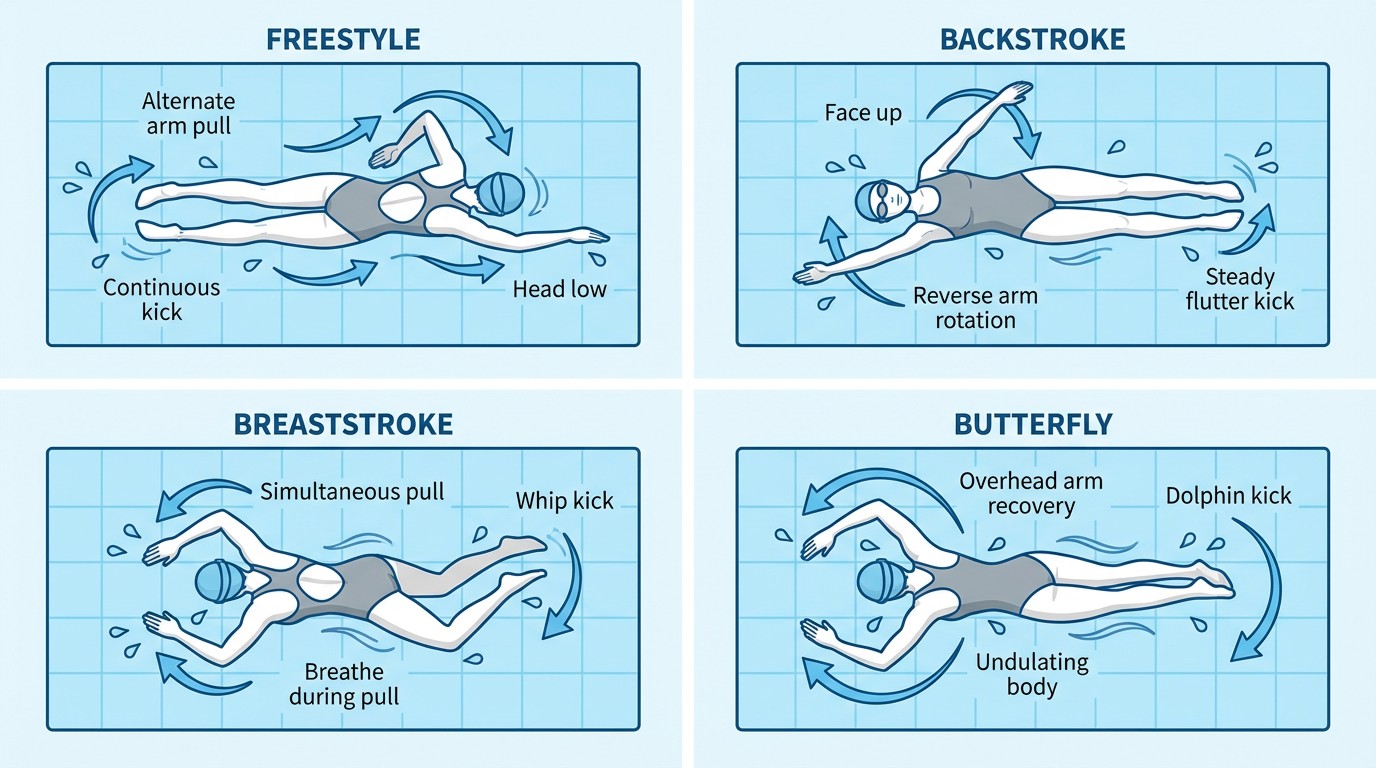
🏊 You can swim on your belly. Move your arms like a windmill! That is called freestyle. It is the FASTEST way to swim!
🔄 You can swim on your back. You look up at the sky! That is called backstroke.
🐸
🐸 You can kick your legs like a frog. That is breaststroke!
🦋 You can flap BOTH arms like a butterfly. That is butterfly! It is really, really hard!
🦋✨
And guess what? When you get to the wall, you can do a FLIP! You spin around under the water and push off with your feet. WHOOOOSH!
🌊🤸🌊
Swimming is so much fun! 💙
How Many Ways Can You Swim?
There are 4 ways to swim in a race. Swimmers call them "strokes." Each stroke uses your arms and legs in a different way.
What Are the 4 Strokes?
Freestyle is the fastest stroke. You lie on your belly and spin your arms one at a time, like a windmill. You kick your feet up and down really fast.
Backstroke is like freestyle, but you swim on your back! You look up at the ceiling and spin your arms behind you.
Breaststroke is the frog stroke. You push your arms out in a circle and kick your legs like a frog. It is the slowest stroke, but many people learn it first.
Butterfly is the hardest stroke. Both arms come out of the water at the same time, and your body moves like a wave. It takes a lot of energy!
What Is a Flip Turn?
When swimmers reach the end of the pool, they do a somersault underwater! They flip over, push off the wall with their feet, and keep going the other way. It is much faster than just turning around.
A Fun Fact
A sailfish can swim 68 miles per hour. The fastest human swimmer goes about 5 miles per hour. Fish are way faster than us!
The 4 Competition Strokes
In competitive swimming, there are exactly 4 strokes. Every race at the Olympics uses one of them (or all four in a special race called the individual medley, or "IM").
Freestyle (Front Crawl)
Freestyle is the fastest stroke. Swimmers lie face-down and alternate their arms in a windmill motion while flutter-kicking. They turn their head to the side to breathe. In the 2024 Paris Olympics, China's Pan Zhanle swam 100 meters freestyle in just 46.40 seconds. That is faster than most people can run!
Backstroke
Backstroke is the only stroke where you start in the water instead of diving off a block. Swimmers lie on their backs and alternate their arms, with a flutter kick. Because you face up, you cannot see where you are going. Backstrokers count their strokes and look for flags hanging over the pool to know when the wall is near.
Breaststroke
Breaststroke is the oldest known swimming stroke. Swimmers pull their arms in a heart shape, then kick their legs out like a frog. It is the slowest of the four strokes, but it has very strict rules. If you kick wrong or touch the wall with one hand instead of two, you get disqualified!
Butterfly
Butterfly was invented in the 1930s when swimmers found a faster way to do breaststroke. Both arms recover over the water at the same time, and the legs do a "dolphin kick," moving together like a mermaid tail. Most swimmers say butterfly is the most tiring stroke.
The Flip Turn
When a freestyle or backstroke swimmer reaches the wall, they do a front somersault underwater, plant their feet on the wall, and push off. This is called a flip turn (or tumble turn). A good flip turn can save half a second per lap. In a long race, that adds up to a huge advantage.
Why Swimming Is Great Exercise
Swimming works almost every muscle in your body. It is easy on your joints because the water holds you up. An hour of swimming can burn 400 to 700 calories, about the same as running. Plus, you learn a skill that could save your life someday.
Four Strokes, Four Biomechanical Problems
Competitive swimming has four legal strokes, each with distinct biomechanics. Not just cosmetic differences. Each stroke solves the same physics problem (moving a human body through a fluid 800 times denser than air) in a completely different way.
Freestyle: The Asymmetric Engine
Freestyle (technically "front crawl," since "freestyle" means "any stroke you want") alternates arm pulls with a continuous flutter kick. Speed comes from the catch: the moment the hand enters the water and grips it like a paddle. Elite swimmers angle their hand and forearm to create a large surface area, pulling water backward while their body rolls side to side. Pan Zhanle's world record 46.40 seconds in the 100m freestyle at the 2024 Paris Olympics translates to 2.16 meters per second, or about 4.8 mph.
Backstroke: Swimming Blind
Backstroke swimmers face upward, which creates a unique navigation problem. They cannot see the approaching wall. Competition pools hang "backstroke flags" 5 meters from each wall. Swimmers count their strokes from the flags to the wall, a different count for each swimmer based on their height and stroke length. Mistiming this count means either crashing into the wall or turning too early and losing distance.
Breaststroke: The Drag Penalty
Breaststroke generates the most frontal drag of any stroke because the arms and legs recover underwater, pushing against the direction of travel. Its simultaneous frog kick creates a propulsive phase followed by a high-drag recovery phase, making breaststroke 30-40% slower than freestyle over the same distance. The 100m breaststroke world record (56.88 seconds, Adam Peaty, 2019) is over 10 seconds slower than the 100m freestyle record.
Butterfly: The Undulation
Butterfly uses a full-body undulation, a wave that starts at the chest and travels down through the hips, legs, and feet. Both arms recover simultaneously over the water. Dolphin kick (both legs together) provides about 70% of the propulsion. Butterfly is the second-fastest stroke after freestyle, but it is the most metabolically expensive. Heart rate during butterfly typically runs 10-15 beats per minute higher than freestyle at the same perceived effort.
The Physics of Flip Turns
A flip turn converts horizontal momentum into a rotation, then redirects it horizontally in the opposite direction. Conservation of momentum applies: the tighter the tuck during the somersault, the faster the rotation (the same principle that makes figure skaters spin faster when they pull their arms in). Elite swimmers complete the entire rotation in about 0.5 seconds. The wall push generates forces of 2 to 3 times body weight, briefly accelerating the swimmer to speeds faster than their swimming speed.
Humans vs. Fish
The sailfish holds the unofficial speed record at 68 mph (30.4 m/s). Even a bluefin tuna cruises at 43 mph. Pan Zhanle's world record speed of 4.8 mph would not outrun a sea turtle (22 mph). The difference is body shape: fish have evolved fusiform (torpedo-shaped) bodies over hundreds of millions of years. Humans are flat-fronted, wide-shouldered, and create enormous frontal drag. Our hip-driven kick is biomechanically inferior to a fish's body-length undulation.
Fluid Dynamics at Human Scale
Swimming is applied fluid dynamics at low Reynolds numbers (relative to most engineering applications). A competitive swimmer operates at Re ≈ 10⁶, well into the turbulent flow regime. Primary challenge: minimizing pressure drag (form drag) while maximizing propulsive force from the arms and legs.
Where ρ is water density (998 kg/m³), v is velocity, C_d is the drag coefficient (approximately 0.3-1.0 for a human swimmer depending on body position), and A is the frontal cross-sectional area. Streamlining (reducing A and C_d) matters more than raw power at competitive speeds.
Propulsion Mechanisms by Stroke
Freestyle propulsion comes primarily from the hand and forearm acting as a hydrofoil during the pull phase. Berger et al. (1995) demonstrated that approximately 85-90% of freestyle propulsion comes from the arms, with the flutter kick contributing primarily to body position stability rather than forward thrust. This ratio inverts in breaststroke and butterfly, where the kick contributes 50-70% of propulsive force.
Catch phase separates elite swimmers from good ones. Early Vertical Forearm (EVF) technique, where the forearm rotates to a near-vertical position as early as possible during the pull, increases the effective paddle area from hand-only (~150 cm²) to hand-plus-forearm (~600 cm²). This quadruples propulsive surface area without increasing metabolic cost significantly.
Turn Biomechanics
Research by Lyttle et al. (1999) measured peak forces of 1,500-2,000 N during competitive flip turn wall pushes. Push-off velocity (typically 2.5-3.0 m/s) exceeds maximum swimming velocity, making the wall phase the fastest portion of each lap. This is why turns are called "free speed" in coaching.
Drag Reduction Technologies
During 2008-2009, the "supersuit" era demonstrated the power of drag reduction. Polyurethane bodysuits trapped air against the skin, reducing effective density and frontal drag. The Speedo LZR Racer and Arena X-Glide were the most prominent examples. In 2009 alone, 130+ world records fell. FINA banned non-textile suits in 2010, resetting the competitive baseline. Many records set in that era stood for over a decade. The 100m freestyle record set by César Cielo in a polyurethane suit (46.91, 2009) was not broken in textile until Pan Zhanle's 46.80 in 2023, fourteen years later.
Metabolic Cost and Energy Systems
Swimming engages all three energy systems. A 50m sprint (≈20-25 seconds) is predominantly anaerobic alactic (ATP-PCr). A 200m event (≈1:40-2:00) taxes the anaerobic lactic (glycolytic) system heavily, producing lactate concentrations of 12-15 mmol/L. Distance events (800m, 1500m) shift to aerobic metabolism. Butterfly's higher metabolic cost comes from the simultaneous bilateral arm recovery and the full-body undulation, which recruits more muscle mass than any other stroke.
Swimming at 1.0 m/s requires roughly three times the oxygen consumption of running at the same speed, because propulsion through water is dramatically less efficient than bipedal locomotion on land. This is why even elite runners struggle in the pool.
The Pan Zhanle Anomaly
Pan Zhanle's 46.40 at Paris 2024 was 0.40 seconds faster than his own previous world record, an enormous margin in a sport where records typically fall by hundredths. His opening 50m split of 22.28 was the fastest in the field, and his closing 50m of 24.12 was also the fastest closing split of any finalist. He led from start to finish, winning by 1.08 seconds over Kyle Chalmers, the largest margin of victory in the Olympic 100m freestyle since 1928. Sports scientists noted that Pan's ability to maintain speed in the second half, despite going out at a blistering pace, suggests either superior lactate buffering capacity, exceptional underwater technique off the turn, or both.
What Your Kid Is Actually Doing in That Pool
Your child told you about the 4 swimming strokes: freestyle, backstroke, breaststroke, and butterfly. They probably mentioned flip turns and how butterfly is really hard. All correct. Here is the fuller picture of what competitive swimming involves, and why it might be the best sport you can put a kid in.
The Injury Profile Advantage
Swimming has the lowest injury rate of any major youth sport. A 2009 study in the American Journal of Sports Medicine found that competitive swimmers aged 8-18 had an injury rate of 1.0-1.5 injuries per 1,000 hours of training. Compare that to youth soccer (4.0-5.0), basketball (3.0-4.0), or gymnastics (4.0-8.0). The buoyancy of water eliminates impact loading on developing joints. Overuse injuries (primarily shoulder impingement, "swimmer's shoulder") do occur but are largely preventable with proper technique and volume management.
Drowning Prevention
Drowning is the leading cause of death for children ages 1-4 in the United States, and the second leading cause for ages 5-14, according to the CDC. A 2009 study by Brenner et al. in Archives of Pediatrics and Adolescent Medicine found that formal swimming lessons reduced the risk of drowning by 88% in children ages 1-4. Teaching a child to swim is, statistically, one of the most impactful safety interventions a parent can make.
The Strokes as Developmental Tools
Each stroke develops different motor patterns. Freestyle and backstroke develop contralateral coordination (opposite arm/opposite leg timing). Breaststroke develops bilateral symmetry. Butterfly develops kinetic chain coordination, with the wave starting at the chest and propagating through the hips, knees, and ankles. The individual medley (IM), which requires all four strokes in a single race, demands the broadest neuromuscular skill set of any swimming event.
Flip Turns and Proprioception
Flip turns are not just a racing technique. They develop proprioception (awareness of body position in space), vestibular function (the inner ear's ability to track rotation), and spatial reasoning (calculating distance from the wall during approach). Children who master flip turns are performing a rapid, complex, multi-axis rotation while managing breath hold and redirecting momentum. It is one of the most neurologically demanding skills in youth sports.
The Exercise Numbers
Swimming burns 400-700 calories per hour depending on stroke and intensity, comparable to running. A 2017 study in the British Journal of Sports Medicine found that regular swimmers had a 28% lower risk of all-cause mortality and a 41% lower risk of cardiovascular mortality compared to non-exercisers. The effect size was comparable to running, but swimming showed additional benefits for blood pressure and pulmonary function due to the respiratory resistance of breathing against water.
What Your Kid Wrote
This article started from a handwritten note: "There are 4 strocks, freestyle, backstrock, breststrock and bouterfla. When you swim I lap and want to turn around you fliptarn." Every detail is correct. There are four strokes. You do flip turns at the wall. Butterfly is spelled with flair. The impulse to teach someone else what you just learned is, by itself, worth celebrating.
Sources
- World Aquatics. "Pan Zhanle sets 100m Freestyle World Record." Paris 2024. worldaquatics.com
- Berger, M.A. et al. (1995). "Determining propulsive force in front crawl swimming." Journal of Biomechanics, 28(8), 971-978.
- Brenner, R.A. et al. (2009). "Association between swimming lessons and drowning in childhood." Archives of Pediatrics and Adolescent Medicine, 163(3), 203-210.
- CDC Drowning Facts. cdc.gov
- Oja, P. et al. (2017). "Associations of specific types of sports and exercise with all-cause and cardiovascular-disease mortality." British Journal of Sports Medicine, 51(10), 800-812.
- Lyttle, A. et al. (1999). "Analysis of the wall push phase in swimming turns." Journal of Strength and Conditioning Research, 13(1).