
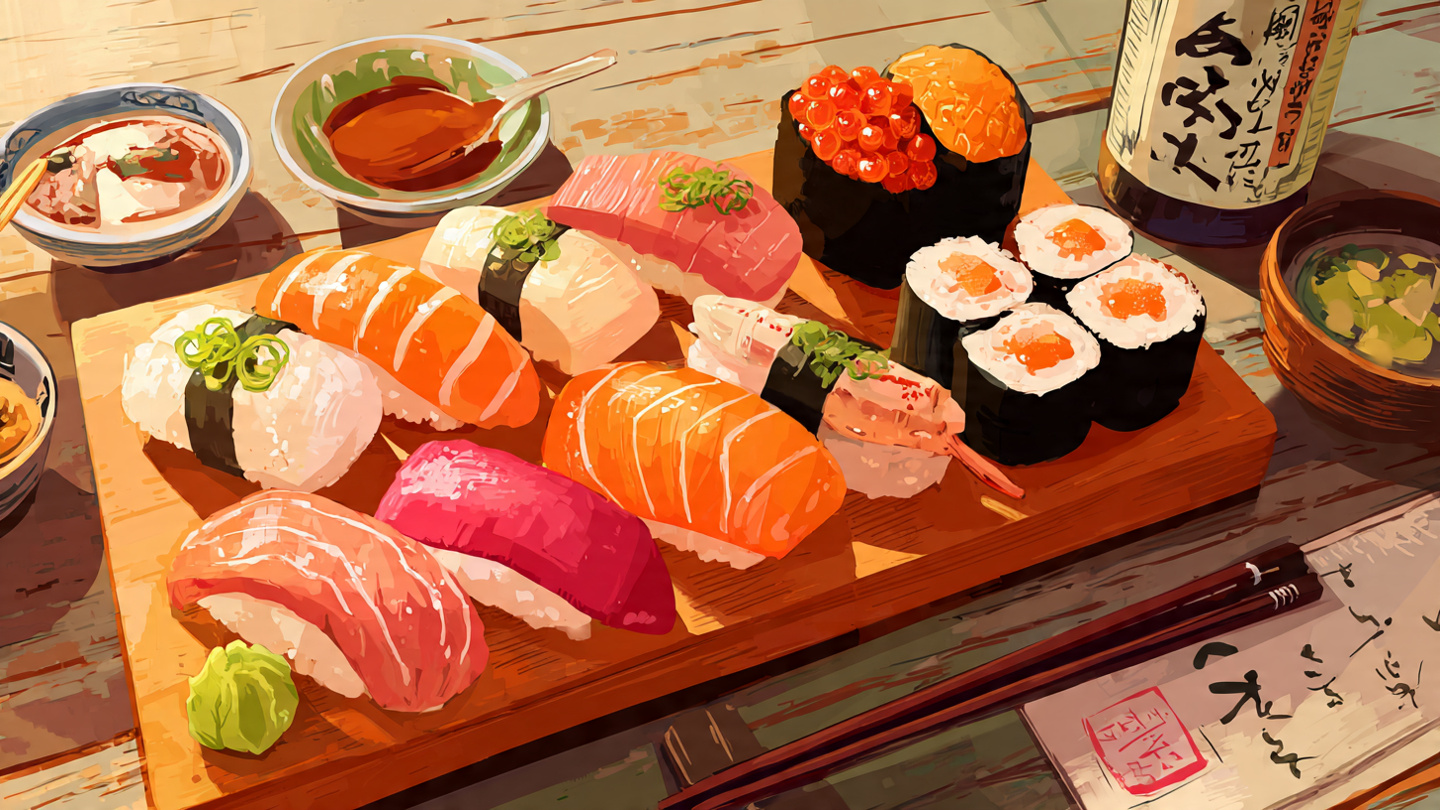
🍣🐟
Sushi is a yummy food from Japan! It has rice and fish. 🍚
Some sushi is wrapped in seaweed. It looks like a little blanket! 💚
People eat sushi with chopsticks. Have you ever tried it? 🥢😋
What Is Sushi?
Sushi is a special food from Japan. It is made with sticky rice, fish, vegetables, and sometimes seaweed. The rice is mixed with a little vinegar to make it taste tangy and sweet.
How Is It Made?
A sushi chef spreads rice on a sheet of seaweed, adds fish or vegetables, and rolls it up tight. Then they cut it into little round pieces. Some sushi is just a ball of rice with a slice of fish on top!
Fun Ways to Eat Sushi
People dip sushi in soy sauce, a salty brown liquid. Some people add wasabi, a green paste that is VERY spicy! You can eat sushi with chopsticks or even with your fingers. In Japan, eating sushi with your hands is totally okay!
Did You Know?
In some restaurants, sushi travels around on a little conveyor belt! You sit at the counter and pick the plates you want as they go by. It's like a food train! 🚂
What Is Sushi?
Sushi is one of Japan's most famous foods, but the word "sushi" doesn't actually mean "raw fish" — it refers to the vinegared rice that is the base of every sushi dish. The rice is seasoned with rice vinegar, sugar, and salt, then combined with toppings or fillings like fish, shrimp, vegetables, or egg.
A Surprising History
Sushi started over 1,000 years ago as a way to preserve fish. People in Southeast Asia packed fish in rice and let it ferment for months. The rice kept the fish from going bad. Back then, people threw away the rice and only ate the fish! It took hundreds of years before someone decided the rice was delicious too.
Types of Sushi
- Nigiri: A small mound of rice with a slice of fish on top
- Maki: Rice and fillings rolled in seaweed and sliced into pieces
- Temaki: A cone-shaped hand roll you eat like an ice cream cone
- Sashimi: Sliced raw fish without rice (technically not sushi!)
- Chirashi: A bowl of sushi rice topped with scattered pieces of fish and vegetables
Sushi Chefs Are Artists
Becoming a sushi chef in Japan takes years of training. Apprentices spend their first years just learning to cook rice perfectly and clean fish properly. A master sushi chef, called an itamae, knows how to select the freshest fish, cut it at exactly the right angle, and shape each piece by hand. In Japan, sushi-making is considered an art form.
Sushi Around the World
Today, sushi is eaten in almost every country. Different places have added their own twists: Brazil has sushi with cream cheese and mango, America has deep-fried sushi rolls, and the Philippines has sushi made with local tropical fish. There are over 45,000 sushi restaurants worldwide!
From Fermented Fish to Global Phenomenon
Sushi's origin story is nothing like its modern image. The ancestor of sushi, called narezushi, originated in Southeast Asia around the 2nd century CE as a preservation method. Fish was salted, packed in cooked rice, and left to ferment for months — sometimes years. The lactic acid produced by fermentation preserved the fish, essentially pickling it. The rice was discarded after serving its purpose. You can still try narezushi at Lake Biwa in Japan's Shiga Prefecture, where funazushi (fermented crucian carp) has been made for over 1,000 years.
The Edo Revolution
The sushi we recognize today was born in Edo (modern Tokyo) in the early 1800s. A chef named Hanaya Yohei is credited with inventing nigiri-zushi around 1824. Instead of fermenting fish for months, he placed fresh fish on top of vinegared rice and served it immediately from a street stall. This was fast food for a booming city. Edo had a massive fishing industry in Tokyo Bay, and nigiri-zushi was the perfect way to sell the day's catch quickly.
The Science of Freshness
Why can you eat raw fish in sushi but not raw chicken? It comes down to biology. Fish muscle tissue has far fewer pathogenic bacteria than land animals because fish are cold-blooded — their body temperature doesn't support the same bacteria that thrive in warm-blooded animals. However, raw fish can carry parasites like Anisakis worms. That's why sushi-grade fish in the US must be flash-frozen at -35°C (-31°F) for 15 hours or -20°C (-4°F) for 7 days (FDA guidelines). Freezing kills parasites while preserving texture and flavor.
The Sushi Economy
Sushi drives a massive global economy. The annual Tsukiji tuna auction (now at Toyosu Market in Tokyo) regularly produces record-breaking sales. In 2019, a 278-kilogram bluefin tuna sold for $3.1 million. Bluefin tuna is the most prized sushi fish, and its popularity has pushed wild populations to critically endangered levels, raising serious sustainability questions.
Sushi Technology
Modern sushi has embraced technology. Kaiten-zushi (conveyor belt sushi), invented by Yoshiaki Shiraishi in 1958, democratized sushi by making it affordable. Today, some conveyor belt restaurants use AI cameras to track which plates are popular and adjust production in real time. Sushi robots can produce 2,400 nigiri per hour, compared to about 200 for a human chef. Yet the highest-end sushi restaurants (omakase counters) still command $300-500 per person specifically because everything is handmade.
Sushi: Preservation, Globalization, and the Politics of Raw Fish
Sushi is arguably the most successful food export in modern history. A dish that was virtually unknown outside Japan before 1970 is now available in gas stations across the American Midwest. Understanding how that happened requires tracing three intertwined threads: food science, cultural economics, and marine ecology.
The Biochemistry of Fermentation to Freshness
Original sushi (narezushi) relied on lacto-fermentation. Bacteria from the genus Lactobacillus metabolize carbohydrates in the rice, producing lactic acid. As pH drops below 4.6, the environment becomes inhospitable to Clostridium botulinum and other dangerous pathogens, effectively preserving the fish. This is the same biochemistry behind kimchi, sauerkraut, and yogurt.
The shift to vinegared rice in the Edo period replaced biological acidification with chemical acidification — acetic acid (vinegar) achieved the same low pH immediately. This was a paradigm shift: sushi went from a preservation technique requiring patience to a preparation technique requiring skill.
The Globalization of Sushi
Sushi's spread outside Japan followed a specific pattern documented by sociologist Sasha Issenberg in The Sushi Economy (2007). Key milestones:
- 1966: Kawafuku, the first sushi bar in the US, opens in Los Angeles, catering to Japanese businessmen
- 1970s: The California Roll (attributed to either Ichiro Mashita or Hidekazu Tojo) eliminates the psychological barrier of visible seaweed and raw fish
- 1980s: Japanese economic boom creates cultural cachet; sushi becomes associated with sophistication and wealth in Western markets
- 1990s-2000s: Supermarket sushi and conveyor belt chains democratize access; global sushi market reaches $14 billion annually
The California Roll deserves particular attention as a case study in cultural adaptation. By inverting the roll (rice outside, nori inside), substituting avocado for toro (fatty tuna), and using cooked crab instead of raw fish, it addressed every Western objection to traditional sushi while maintaining the structural concept. It is, arguably, the single most important dish in the globalization of Japanese cuisine.
The Bluefin Crisis
Sushi's global popularity has created an ecological crisis. Atlantic bluefin tuna (Thunnus thynnus) populations declined by an estimated 72% between 1970 and 2010 (ICCAT data). Pacific bluefin (T. orientalis) fell to approximately 2.6% of its unfished biomass by 2014. The fish's biology makes it uniquely vulnerable: bluefin are apex predators that take 8-12 years to reach maturity and cannot be farmed from egg to market at commercial scale (unlike salmon).
International management through ICCAT (International Commission for the Conservation of Atlantic Tunas) has been criticized as inadequate. Japan consumes approximately 80% of the global bluefin catch. Strict quotas implemented after 2010 have shown some recovery — Atlantic bluefin biomass roughly doubled between 2012 and 2022 — but the species remains vulnerable, and illegal, unreported, and unregulated (IUU) fishing persists.
Itamae: The Art and Apprenticeship
Traditional sushi training in Japan follows a rigid apprenticeship model. At elite establishments, an apprentice (wakiita) spends 2-3 years on rice preparation alone before touching fish. The full journey to itamae (master chef) traditionally takes 10+ years. Jiro Ono, subject of the documentary Jiro Dreams of Sushi (2011), exemplifies this philosophy — he has been making sushi for over 70 years and still works to improve his technique daily at age 100.
This tradition faces tension with modernity. Sushi academies now offer 2-8 week courses that produce technically competent chefs. Purists argue this strips sushi of its cultural depth; pragmatists point out that the global demand for sushi chefs cannot be met by a decade-long training pipeline.
Sushi: A 2,000-Year Journey from Preservation Hack to Global Commodity
Writing about sushi for a kids' news site means resisting the temptation to flatten it into "Japanese food with raw fish." The real story is richer: sushi is a case study in how food technology, economics, cultural exchange, and ecological crisis intersect. Every piece of nigiri on a conveyor belt carries 2,000 years of innovation and a growing set of sustainability questions.
Origins: Fermentation as Technology
The ancestral form, narezushi, originated in the Mekong Delta region of Southeast Asia, likely around the 2nd-4th century CE, reaching Japan by the 8th century (earliest written reference: the Yōrō Code of 718 CE). The mechanism is straightforward lacto-fermentation: Lactobacillus species convert rice starches to lactic acid, dropping pH below the threshold for Clostridium botulinum toxin production (pH 4.6). The fish, packed in the acidic rice matrix, could be preserved for months to years.
Funazushi, made from nigorobuna (Carassius buergeri grandoculis) at Lake Biwa in Shiga Prefecture, is the last surviving representative of this tradition. The fish ferments for 1-3 years. The flavor is intensely sour and funky — closer to aged cheese than anything at your local sushi bar. It's worth noting that this preservation logic is identical to Scandinavian surströmming, Korean jeotgal, and Filipino bagoong. Sushi's origin is not uniquely Japanese; it's a pan-Asian fermentation technology that Japan refined into a culinary art.
The Edo Transformation
Three developments converged in Edo-period Tokyo to create modern sushi. First, rice vinegar production scaled up in the 17th century (particularly from the Mikawa region), making instant acidification commercially viable. Second, Edo's location on Tokyo Bay provided abundant fresh seafood. Third, the city's population boom (over 1 million by the early 1700s, likely the world's largest city) created demand for fast, portable food.
Hanaya Yohei's innovation around 1824 was not just culinary — it was a business model. Nigiri-zushi was street food sold from yatai (food stalls), priced for laborers and merchants. The pieces were larger than today's (roughly twice the size), designed to be eaten in two bites. The transition from months-long fermentation to minutes-long preparation was, at its core, a supply chain revolution.
Food Safety: Why Raw Fish Works
The safety profile of raw fish consumption is frequently misunderstood. Several biological factors make fish safer to eat raw than terrestrial animals:
- Muscle physiology: Fish are poikilotherms; their tissue does not support mesophilic human pathogens (Salmonella, E. coli O157:H7) as readily as mammalian or avian muscle
- Bacterial load: Fresh marine fish muscle is effectively sterile; contamination occurs post-harvest through handling and cross-contamination
- Parasite risk: The primary hazard is parasitic — Anisakis simplex (herring worm) and Diphyllobothrium (fish tapeworm). FDA regulation 21 CFR 123.3 requires commercial raw fish to be frozen at -20°C for 168 hours or -35°C for 15 hours to kill parasites
Japan's approach differs: the regulatory framework relies more on supply chain freshness and chef expertise than mandatory freezing. Japanese itamae are trained to visually inspect fish for parasites during preparation. The result is that high-end sushi in Japan often uses fish that has never been frozen, which alters texture perceptibly (frozen-thawed fish loses some cellular integrity due to ice crystal formation, resulting in slightly softer texture).
The Bluefin Question
No serious treatment of sushi can avoid the bluefin tuna crisis. The numbers are stark:
- Pacific bluefin tuna (Thunnus orientalis) spawning stock biomass fell to 2.6% of unfished levels by 2014 (ISC Stock Assessment, 2014)
- Atlantic bluefin (T. thynnus) declined ~72% from 1970 peak (ICCAT, 2009)
- Southern bluefin (T. maccoyii) reached ~5% of original biomass by 2009 (CCSBT)
The irony is that bluefin tuna was not traditionally prized in Japanese cuisine. Toro (fatty bluefin belly) was considered undesirable until the mid-20th century — too oily, too perishable. The rise of toro as the pinnacle of sushi coincided with post-war refrigeration technology and, critically, with the development of air freight. By the 1970s, bluefin caught in the Atlantic could be flown to Tsukiji Market within 48 hours, creating a global commodity market for a fish that had previously been a local catch.
Recent management has shown partial success. ICCAT's strict catch limits after 2010, combined with improved enforcement, have allowed Atlantic bluefin biomass to approximately double by 2022. Japan's Kindai University has pioneered closed-cycle bluefin aquaculture (egg-to-market farming), though commercial scaling remains challenging due to the fish's 15-year growth cycle and high mortality in captive juvenile stages.
Cultural Economics of Omakase
The coexistence of $5 conveyor belt sushi and $500 omakase counters is an instructive economic phenomenon. Omakase ("I'll leave it to you") dining is essentially a Veblen good — demand increases with price because the price itself signals exclusivity. But it's also genuinely different food. A top itamae at Sukiyabashi Jiro or Saito selects fish personally at the market, ages certain cuts (a technique called jukusei, now increasingly common, where fish is rested for days to weeks to develop umami through enzymatic breakdown of ATP to inosine monophosphate), and adjusts rice temperature, wasabi quantity, and soy sauce application for each piece.
Whether this craft justifies a 100x price premium over kaiten-zushi is a question that says more about the consumer than the product. What's undeniable is that the apprenticeship tradition that produces these chefs is under pressure: the 10-year training pipeline cannot scale, and younger Japanese increasingly choose faster career paths.
Sources
- Issenberg, S. The Sushi Economy: Globalization and the Making of a Modern Delicacy. Gotham Books (2007).
- Mouritsen, O.G. Sushi: Food for the Eye, the Body, and the Soul. Springer (2009).
- Bestor, T.C. Tsukiji: The Fish Market at the Center of the World. University of California Press (2004).
- Corson, T. The Story of Sushi: An Unlikely Saga of Raw Fish and Rice. Harper Perennial (2008).
- ISC (International Scientific Committee for Tuna and Tuna-like Species). "Stock Assessment of Pacific Bluefin Tuna" (2014).
- ICCAT Standing Committee on Research and Statistics. "Report of the 2022 Atlantic Bluefin Tuna Stock Assessment Session."
- FDA. "Fish and Fishery Products Hazards and Controls Guidance." Chapter 5: Parasites (4th Edition, 2021).
- Ono, J., Yoshino, M. Jiro Dreams of Sushi [documentary]. Magnolia Pictures (2011).