
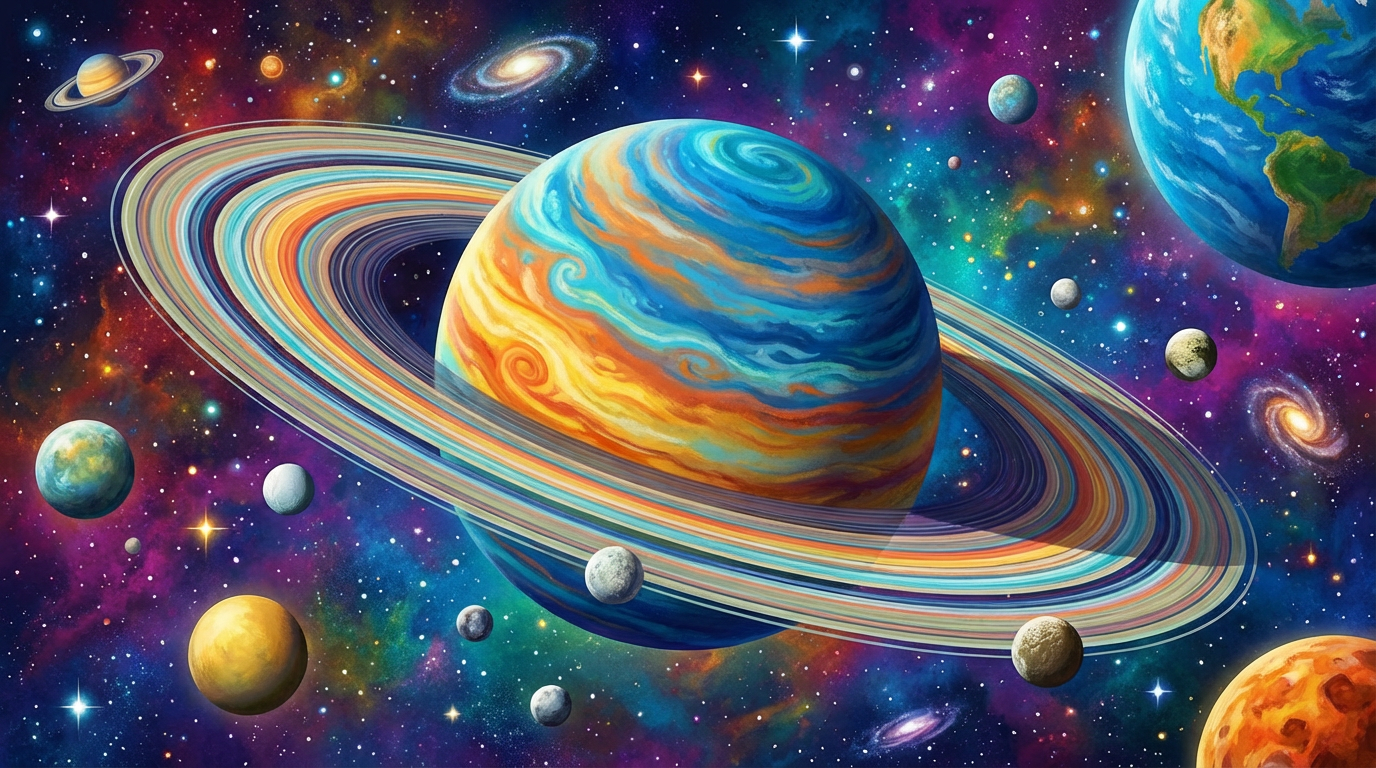
🪐 Saturn is a big, round planet way up in space!
It has BEAUTIFUL rings around it. Like a giant hula hoop! 💫
The rings are made of ice and rocks! Some pieces are tiny. Some are BIG like a house! 🏠
Right now, the rings look like they are hiding! But they are NOT gone. 🙈
Saturn just turned a little bit. It is like looking at a plate from the side. See how thin it gets? 🍽️
Do not worry! The rings will come back! Saturn wobbles back and forth, very slowly. We will see the big rings again soon! ✨
Saturn is one of the most beautiful planets in our solar system. It has huge rings made of billions of pieces of ice and rock. Some pieces are as small as grains of sand. Others are as big as houses.
What Is Happening?
Right now, if you look at Saturn through a telescope, the rings are almost invisible. They look like a super thin line instead of the wide, bright rings you see in pictures.
The rings are not going away. Saturn is tilted, and it slowly wobbles as it goes around the Sun. Sometimes Saturn tilts its rings toward us, and we see them wide open. Other times, Saturn tilts them sideways. That is what is happening now.
How Big Are the Rings?
Saturn's rings stretch 282,000 kilometers across. That is wide enough to fit about 22 Earths in a row! But the rings are only about 10 meters thick. That is about as tall as a three-story building. Incredibly wide but incredibly thin.
If you pointed a telescope at Saturn tonight, you might be confused. The planet's famous rings have all but vanished. They have not been destroyed. They are still there, all 282,000 kilometers of them. You just cannot see them right now.
Why the Rings Disappear
Saturn's axis is tilted 26.7 degrees relative to its orbit around the Sun. As Saturn orbits once every 29.4 Earth years, we see the rings from different angles. Sometimes wide open, sometimes perfectly edge-on. This edge-on alignment is called a ring plane crossing. It happens roughly every 13 to 15 years. The last one was in September 2009.
What Are the Rings Made Of?
The rings are made almost entirely of water ice, mixed with small amounts of rocky debris and dust. The pieces range from microscopic grains to chunks the size of houses.
A Ring That Will Not Last Forever
NASA's Cassini spacecraft measured that the rings are losing material at a rate that would drain them completely in about 100 to 300 million years. Saturn is 4.5 billion years old. The rings may have formed relatively recently, possibly within the last 100 million years when a moon nicknamed Chrysalis got too close and was torn apart by tidal forces (Wisdom et al., Science, 2022).
When Will We See Them Again?
By around 2032, the rings will be at their maximum tilt again. Then the slow wobble continues, and they will go edge-on again around 2039.
The Geometry of Disappearing Rings
Saturn's axial tilt of 26.73 degrees creates a cycle visible from Earth. As Saturn orbits the Sun every 29.46 years, our viewing angle of the rings changes continuously. Twice per orbit, Earth passes through the ring plane, and the rings become nearly invisible. This is called a ring plane crossing.
Orbital Mechanics: Why the View Changes
Imagine Saturn's orbit as a flat oval on a table. Now tilt Saturn's axis 26.73 degrees. As Saturn moves around its orbit, sometimes the north pole tilts toward Earth (rings open, seen from above), sometimes the south pole tilts toward us (rings open, seen from below), and twice per orbit, the tilt is sideways to us (rings edge-on, nearly invisible).
At maximum opening: ~26.73 degrees (full face view)
At ring plane crossing: ~0 degrees (edge-on)
The rings are 282,000 km wide but only ~10 m thick.
At edge-on: apparent thickness from Earth = 10 m / sin(viewing angle)
At 0.01 degrees: apparent width = 10 / sin(0.01°) ≈ 57 km, still razor-thin compared to 282,000 km across.
What the Rings Are Made Of
The rings are 99.9% water ice by mass, with traces of silicate rock and organic compounds called tholins (which give some rings a reddish tint). Particle sizes range from micrometers to about 10 meters. The rings are organized into distinct bands (A, B, C, D, E, F, G) separated by gaps. The most famous gap, the Cassini Division, is 4,800 km wide and caused by an orbital resonance with Saturn's moon Mimas.
Ring Rain: The Rings Are Disappearing (For Real This Time)
Cassini measured charged ice particles falling from the rings into Saturn's atmosphere at 432 to 2,870 kg per second. At the midpoint rate of about 1,600 kg/s, the entire ring system would drain in roughly 292 million years. Saturn is 4.5 billion years old. So the rings we see today are relatively young.
The leading hypothesis: about 100 to 160 million years ago, one of Saturn's moons (nicknamed "Chrysalis") drifted too close to Saturn and crossed the Roche limit, the distance at which tidal forces tear an object apart. The destroyed moon's debris became the rings we see today.
Ring Plane Crossing: The Observational Geometry
Saturn's obliquity (axial tilt) of 26.73 degrees relative to the ecliptic plane creates a periodic variation in the sub-Earth latitude on Saturn. The ring opening angle B, measured as the elevation of Earth above or below Saturn's ring plane, varies sinusoidally with Saturn's orbital period of 29.46 years. Ring plane crossings (B = 0) occur twice per orbit, roughly 14-15 years apart.
During a ring plane crossing, the rings' projected cross-section shrinks from ~282,000 km (face-on) to their physical thickness of approximately 10 meters. Even at high magnification, the rings become invisible to all but the largest telescopes. The 2025 crossing is the first since September 2009 and provides unique observational opportunities.
The Roche Limit and Ring Formation
The Roche limit is the minimum distance at which a celestial body, held together only by its own gravity, can orbit a more massive body without being torn apart by tidal forces. For a fluid body orbiting Saturn:
Where Rprimary is Saturn's radius and ρ represents density. For a typical icy satellite (ρ ≈ 1.0 g/cm³) orbiting Saturn (ρ ≈ 0.687 g/cm³), the Roche limit is approximately 2.44 × 58,232 km × (0.687/1.0)1/3 ≈ 125,000 km from Saturn's center. Saturn's main rings (A, B, C) all lie within this distance, consistent with a tidally disrupted origin.
Ring Composition: Spectroscopic Evidence
Near-infrared spectroscopy from Cassini's VIMS (Visual and Infrared Mapping Spectrometer) confirmed the rings are predominantly water ice, with absorption bands at 1.5 and 2.0 micrometers. The B ring shows the purest ice signature. The C ring and Cassini Division contain higher fractions of silicate and organic contaminants (tholins), absorbing in the UV and giving a reddish-brown tint.
Cassini's Cosmic Dust Analyzer detected nanometer-scale silicate grains in the E ring (produced by cryovolcanic plumes from Enceladus) and iron-rich particles in the D ring, suggesting meteoritic contamination accumulates over time. The relative purity of the B ring is one of the strongest arguments for a young ring system: prolonged exposure to interplanetary dust should have darkened the rings more than observed.
Cassini's Grand Finale: Data From Between the Rings
In 2017, during its final orbits, Cassini flew 22 times through the 2,000 km gap between Saturn's atmosphere and the D ring. These Grand Finale orbits provided the first direct measurement of ring mass (via gravitational perturbation of Cassini's trajectory) and sampled ring material falling into Saturn's atmosphere. The Ion and Neutral Mass Spectrometer (INMS) detected water, methane, ammonia, carbon monoxide, molecular nitrogen, and carbon dioxide, establishing that ring rain carries complex chemistry into Saturn's upper atmosphere.
The measured infall rate of 4,800-45,000 kg/s (Waite et al., Science, 2018) was 10 times higher than pre-Cassini estimates, accelerating the timeline for ring depletion and strengthening the case that the rings are a transient feature of Saturn, not a primordial one.
- Iess, L. et al., "Measurement and Implications of Saturn's Gravity Field and Ring Mass," Science, 2019.
- Wisdom, J. et al., "Loss of a satellite could explain Saturn's obliquity and young rings," Science, 2022.
- Waite, J.H. et al., "Chemical interactions between Saturn's atmosphere and its rings," Science, 2018.
- Cuzzi, J.N. et al., "An evolving view of Saturn's dynamic rings," Science, 2010.
Saturn's ring plane crossing offers both a viewing challenge and a scientific opportunity. The current edge-on alignment is the first since September 2009.
The Geometry
Saturn's axial tilt of 26.73 degrees combined with its 29.4-year orbital period creates a predictable cycle. The ring system spans approximately 282,000 km in diameter but averages only about 10 meters in thickness, a width-to-thickness ratio of roughly 28 million to one. If you scaled Saturn's rings to the size of a football field, their thickness would be less than a sheet of paper. The Cassini Division alone is 4,800 km wide, created by an orbital resonance with the moon Mimas.
The Rings Are Young (Probably)
This is one of planetary science's biggest recent surprises. Cassini's Grand Finale orbits in 2017 yielded a ring mass of approximately 1.54 × 10¹⁹ kg, about 40% of moon Mimas. This low mass, combined with the high ice purity (the rings should be darker if they had been collecting interplanetary dust for billions of years), constrains their age to roughly 10 to 100 million years (Iess et al., Science, 2019). The rings are not primordial. They are younger than many dinosaurs.
The Chrysalis hypothesis (Wisdom et al., Science, 2022) proposes Saturn once had an additional large moon that entered the Roche limit and was tidally disrupted about 160 million years ago. The disruption simultaneously created the rings and changed Saturn's obliquity to its current 26.73 degrees, elegantly solving two mysteries with one catastrophe.
Ring Rain and the Clock Running Down
Cassini measured material falling from the rings into Saturn's atmosphere at 432 to 2,870 kg per second (Waite et al., Science, 2018). At the midpoint estimate of ~1,600 kg/s, the entire ring system drains in roughly 292 million years. We are watching one of the solar system's most iconic features in its relatively brief middle age. The rings existed before us. They may not exist long after.
Viewing Tips for 2025-2026
Saturn is visible to the naked eye as a bright, steady, yellowish point. Through even a modest telescope (60mm aperture, 50x magnification), the ring geometry is striking. During this edge-on period, the rings appear as a hairline or vanish entirely, giving the planet an oddly naked look. This is actually a great time to spot Saturn's moons (especially Titan, visible at 30x) because the ring glare is minimized.
💬 Talk About It
- For preschoolers (3-4): Hold a plate flat and tilt it. "What happens when we turn it sideways?"
- For kindergartners (5-6): "Saturn's rings are wider than 22 Earths but thinner than a building. Can you think of anything else that is really wide but really thin?"
- For elementary (7+): "The rings might only be 100 million years old. Dinosaurs were already around then. What does that tell you about how old things in space can be?"
- For middle school: "The rings are losing material constantly. Should we care that something beautiful in space is temporary? Are all beautiful things temporary?"
- Iess, L. et al., "Measurement and Implications of Saturn's Gravity Field and Ring Mass," Science, 2019.
- Wisdom, J. et al., "Loss of a satellite could explain Saturn's obliquity and young rings," Science, 2022.
- Waite, J.H. et al., "Chemical interactions between Saturn's atmosphere and its rings," Science, 2018.
- Cuzzi, J.N. et al., "An evolving view of Saturn's dynamic rings," Science, 2010.