
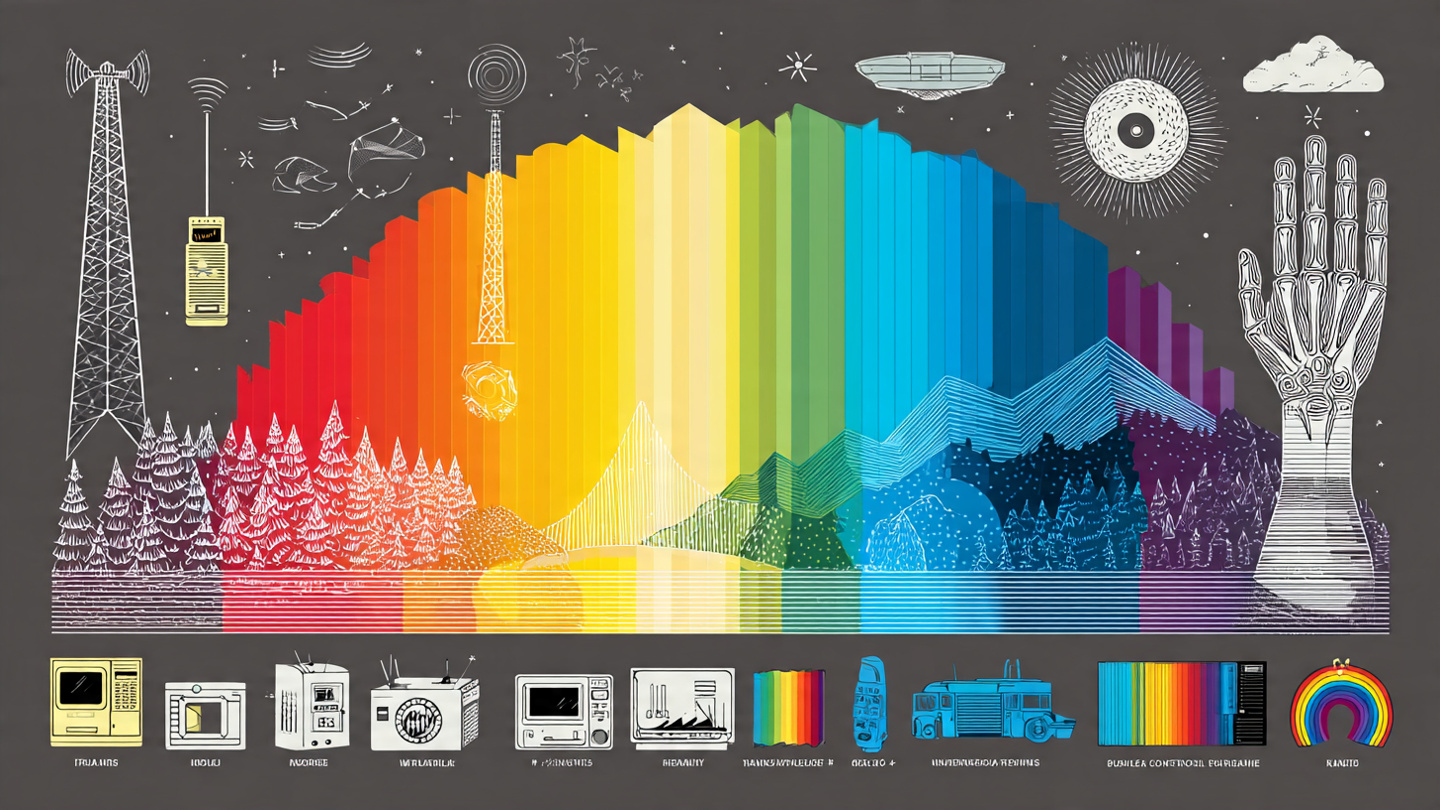
Light is EVERYWHERE! 🌈 Some light you can see, like rainbows. But MOST light is invisible! You cannot see it, but it is all around you RIGHT NOW!
📻
Radio Waves
Talk into a walkie-talkie and your voice zooms through the air on invisible waves! Your friend hears you SO far away! How cool is that?! 📻
🍿
Microwaves
The microwave in your kitchen uses invisible waves to make food HOT! Put in popcorn and... POP POP POP POP POP! 🍿🎉
📺
Infrared
When you press the TV remote, it shoots invisible light at the TV! You cannot see it, but the TV can! Sneaky light! 📺
🌈
Visible Light
This is the ONLY light your eyes can see! Red, orange, yellow, green, blue, and purple. Put them together and you get a RAINBOW! 🌈
☀️
Ultraviolet
The sun makes invisible light called UV. It gives you a sunburn! OUCH! That is why you wear sunscreen! ☀️🧴
🦴
X-Rays
At the doctor, a special camera can see your BONES inside your body! Your bones! It uses X-rays! SO cool! 🦴
⭐
Gamma Rays
Gamma rays come from stars that EXPLODE! BOOM! They are the most powerful light in the whole universe! ⭐💥
ALL of these are the same thing: light! Seven types! You can only see ONE. But they are all around you, all the time! 🤯
Did you know there are SEVEN types of light? You can only see ONE of them! The rest are invisible! Let's meet them all! 👀
📻 Radio Waves - The Longest Ones!
Radio waves are really, really long. Longer than a football field! They carry music to your car radio and voices to your walkie-talkie. When you press the button on a walkie-talkie and talk, your voice turns into radio waves that zoom through the air at the speed of light!
WiFi uses radio waves too! That is how your tablet gets the internet without any wires! 📶
🍿 Microwaves - The Food Heaters!
Microwaves are shorter than radio waves. Your microwave oven uses them to shake water inside your food really fast. When water shakes, it gets hot! That is why wet food heats up faster than dry food.
🔴 Infrared - The Warm Invisible Light!
Everything warm makes infrared light! You make it! Your dog makes it! That is how night-vision goggles work. They can see the infrared light that warm things give off, even in total darkness!
Your TV remote uses infrared to talk to the TV. Next time you press a button, look at the front of the remote with a phone camera. You might see a purple flash! That is the infrared!
🌈 Visible Light - The Only One You Can See!
Out of all seven types, this is the only one your eyes can see. When sunlight goes through rain, it splits into the colors of the rainbow: red, orange, yellow, green, blue, indigo, and violet!
Remember: ROY G BIV! That is how you remember the rainbow colors!
☀️ Ultraviolet (UV) - The Sunburn Maker!
UV light comes from the sun. You cannot see it or feel it, but it can burn your skin! That is why you wear sunscreen. Some animals can see UV light. Bees use it to find flowers! 🐝
🦴 X-Rays - The Bone Seers!
X-rays can go through your skin but NOT through your bones. So when the doctor takes an X-ray picture, your bones show up white and everything else is dark! That is how they check if a bone is broken.
💥 Gamma Rays - The Super Powerful Ones!
Gamma rays are the shortest, most powerful light. They come from exploding stars and nuclear reactions. They are so powerful that special telescopes in space watch for them!
Fun fact: in comic books, gamma rays turned Bruce Banner into the Hulk. In real life, scientists use them very carefully to treat some kinds of cancer! 💚
Everything from your walkie-talkie to a doctor's X-ray machine uses the same thing: electromagnetic radiation. It is a fancy name for waves of energy that travel at the speed of light. The only difference between radio waves and gamma rays is how long the waves are!
📻 Radio Waves
Radio waves have the longest wavelengths, from about 1 millimeter to more than 100 kilometers! They carry signals for:
- AM radio (like 680 AM) uses longer waves that can bounce off the sky at night, so you can hear stations from far away!
- FM radio (like 101.3 FM) uses shorter waves that sound better but do not travel as far
- Walkie-talkies use FRS channels around 462 MHz. That means the waves are about 65 centimeters long, roughly the length of your arm!
- WiFi uses 2.4 GHz and 5 GHz, which are between radio waves and microwaves
🍿 Microwaves
Microwaves are 1 mm to 30 cm long. Your microwave oven uses waves that are 12.2 cm long (2.45 GHz). Why that exact size? Because water molecules absorb that wavelength really well! The waves make water molecules spin back and forth 2.45 billion times per second, which creates friction and heat.
Satellites and cell phone towers also use microwaves to send signals.
🔴 Infrared
Infrared means "below red" because its wavelength is just longer than red light. Everything warmer than absolute zero (-459.67 F) gives off infrared. The warmer something is, the more it emits.
Your TV remote sends pulses of infrared light in a code. Different buttons send different codes. Try this: point your remote at your phone camera and press a button. You will see the infrared LED flashing!
🌈 Visible Light
Visible light is the tiny sliver of the spectrum your eyes evolved to see. It goes from red (longest, about 700 nm) to violet (shortest, about 380 nm). A nanometer (nm) is one billionth of a meter!
Why is the sky blue? Sunlight contains all colors. When it hits air molecules, shorter wavelengths (blue and violet) scatter in all directions more than longer ones (red). Your eyes are more sensitive to blue than violet, so you see a blue sky!
Light travels at 299,792,458 meters per second. That is fast enough to go around Earth 7.5 times in one second!
☀️ Ultraviolet (UV)
UV light has more energy than visible light. The sun produces three types:
- UVA (longest UV) goes through clouds and glass, causes skin aging
- UVB causes sunburns and helps your body make vitamin D
- UVC (shortest UV) is blocked by the ozone layer, which is good because it can damage DNA!
🦴 X-Rays
X-rays have enough energy to pass through soft tissue (skin, muscle) but get absorbed by dense materials (bones, metal). That is why bones show up white on an X-ray image.
A German scientist named Wilhelm Rontgen discovered X-rays in 1895. The first X-ray picture ever taken was of his wife's hand, and you could see her bones and her ring!
💥 Gamma Rays
Gamma rays have the shortest wavelengths and highest energy. They come from:
- Radioactive materials
- Nuclear explosions
- Supernovae (exploding stars)
- Gamma-ray bursts, which are the most powerful explosions in the universe!
NASA's Fermi Space Telescope watches for gamma rays from space. In 2022, it detected the brightest gamma-ray burst ever recorded. It was called "BOAT" (Brightest Of All Time) and came from a star exploding 2.4 billion light-years away!
The electromagnetic spectrum is a continuum of radiation, all traveling at the speed of light (c = 3 x 10⁸ m/s) but differing in wavelength and frequency. The relationship is simple: c = λf, where λ is wavelength and f is frequency. As wavelength decreases, frequency and energy increase.
📻 Radio Waves (> 1 mm)
Radio waves span the widest range of the spectrum. Key bands include:
- AM broadcast: 530-1700 kHz. Long wavelengths (hundreds of meters) diffract around buildings and reflect off the ionosphere at night, giving AM its famous long-range nighttime reception
- FM broadcast: 88-108 MHz. Shorter wavelengths (~3 meters) provide higher fidelity (wider bandwidth) but travel line-of-sight only
- FRS (Family Radio Service): 462/467 MHz, 22 channels, max 2 watts, no license required. Range: 0.5-2 miles typically
- GMRS (General Mobile Radio Service): Same frequencies but up to 50 watts with repeater access. Requires an FCC license ($35, good for 10 years). Range: 5-25+ miles with repeaters
- WiFi: 2.4 GHz (better range, more interference) and 5 GHz (faster speeds, shorter range). WiFi 6E adds 6 GHz
The key difference between FRS and GMRS: power and infrastructure. FRS walkie-talkies are capped at 2 watts and cannot use repeaters. GMRS allows up to 50 watts and can connect to hilltop repeaters that relay your signal for miles.
🍿 Microwaves (1 mm - 30 cm)
Microwave ovens exploit the dielectric heating of water molecules. At 2.45 GHz, water's dipole moment causes rapid oscillation, converting electromagnetic energy to thermal energy. Interestingly, 2.45 GHz is NOT the resonant frequency of water (that is ~20 GHz). The lower frequency was chosen so waves penetrate deeper into food rather than heating only the surface.
Satellite communications, 5G mmWave, and radar all operate in the microwave band.
🔴 Infrared (700 nm - 1 mm)
All objects above absolute zero emit infrared radiation according to Planck's blackbody radiation law. The peak emission wavelength is given by Wien's displacement law: λmax = b/T, where b = 2,897 µm*K. At human body temperature (310 K), peak emission is around 9.3 µm, firmly in the mid-infrared.
Thermal cameras detect infrared and map temperatures. They are used for building energy audits, search-and-rescue, and predictive maintenance on electrical equipment.
🌈 Visible Light (380 - 700 nm)
Our eyes evolved sensitivity to this narrow band because it corresponds to the peak emission of our Sun (surface temperature ~5,778 K, peak at ~500 nm, blue-green). Natural selection favored organisms that could detect the most abundant photons in their environment.
Rayleigh scattering explains sky color: scattering intensity is proportional to 1/λ4. Blue light (450 nm) scatters ~5.5x more than red light (650 nm). At sunset, sunlight travels through more atmosphere, scattering away all blue and leaving red/orange.
☀️ Ultraviolet (10 - 380 nm)
UV radiation is classified by wavelength:
- UVA (315-380 nm): ~95% of UV reaching Earth's surface. Penetrates deep into skin dermis, causes photoaging
- UVB (280-315 nm): ~5% of surface UV. Absorbed by epidermis, causes sunburn, triggers vitamin D synthesis
- UVC (100-280 nm): Absorbed by ozone layer (O3). Used artificially for germicidal applications at 254 nm
SPF 30 sunscreen blocks ~97% of UVB. SPF 50 blocks ~98%. The difference between SPF 30 and 50 is only 1%.
🦴 X-Rays (0.01 - 10 nm)
X-rays are produced when high-speed electrons decelerate rapidly upon hitting a metal target (Bremsstrahlung radiation). Medical X-rays typically operate at 50-150 keV. A chest X-ray delivers about 0.02 mSv of radiation, roughly equivalent to 2.4 days of natural background radiation.
CT scans use rotating X-ray sources to build 3D images from multiple angles. A typical CT scan delivers 1-10 mSv, much more than a single X-ray.
💥 Gamma Rays (< 0.01 nm)
Gamma rays originate from nuclear transitions, unlike X-rays which come from electron transitions. The distinction is about origin, not energy. Key sources:
- Gamma-ray bursts (GRBs): The most energetic events in the universe. A single GRB can release more energy in seconds than our Sun will in its entire 10-billion-year lifetime
- Medical applications: Gamma knife surgery uses focused beams of cobalt-60 gamma rays to treat brain tumors without opening the skull
- PET scans: A radiotracer emits positrons that annihilate with electrons, producing pairs of gamma rays detected to map metabolic activity
Electromagnetic radiation is the propagation of coupled electric and magnetic field oscillations, governed by Maxwell's equations. All EM waves travel at c in vacuum, carrying energy quantized as photons with E = hf, where h = 6.626 x 10⁻³⁴ J*s (Planck's constant). The wave-particle duality of light is fundamental: it exhibits wave behavior (diffraction, interference) and particle behavior (photoelectric effect, Compton scattering).
📻 Radio Waves and Propagation
Radio propagation depends critically on frequency:
- Ground wave (< 2 MHz): AM signals follow Earth's curvature via diffraction, attenuating with distance. Useful for long-range but low bandwidth
- Sky wave (2-30 MHz, HF): Signals refract off the ionosphere's E and F layers. The ionosphere's electron density varies diurnally, explaining why HF propagation changes dramatically between day and night. During solar maxima, the Maximum Usable Frequency (MUF) increases
- Line-of-sight (> 30 MHz): VHF, UHF, and microwave signals travel in straight lines. Range is limited by the radio horizon: d(km) = 4.12 * sqrt(h(m)), where h is antenna height. A 10-meter antenna gives ~13 km horizon
GMRS operates at UHF (462/467 MHz), purely line-of-sight. Repeaters on hilltops extend range by receiving on one frequency and retransmitting on another (with a standard 5 MHz offset). Modern digital modes like DMR can share channels via time-division multiplexing.
🔬 Spectroscopy: Reading the Universe
Every element produces a unique emission spectrum when its electrons transition between energy levels (E = -13.6 eV * Z2/n2 for hydrogen-like atoms). By analyzing the spectral lines of starlight, astronomers determine:
- Composition: Helium was discovered in the Sun's spectrum before it was found on Earth (1868)
- Temperature: The ratio of spectral line intensities reveals stellar surface temperature
- Velocity: Doppler shift of spectral lines gives radial velocity. Redshift (z = Δλ/λ) measures how fast objects are receding. Hubble used this to discover the expanding universe
🦴 X-Ray Crystallography
When X-rays hit a crystal, they diffract off the atomic lattice planes. Bragg's law (nλ = 2d*sinθ) relates the diffraction angle to the atomic spacing. This technique revealed:
- The double helix structure of DNA (Rosalind Franklin's Photo 51, 1952)
- The structure of hemoglobin, insulin, and thousands of proteins
- The atomic arrangement of every crystalline material we understand
Rosalind Franklin's contribution to the DNA discovery is one of science's most significant uncredited achievements. Watson and Crick used her X-ray diffraction data without her knowledge or permission.
⚛️ Ionizing vs. Non-Ionizing Radiation
The boundary is roughly 10 eV (124 nm, deep UV). Above this energy, photons can eject electrons from atoms (ionization), potentially damaging DNA:
- Non-ionizing: Radio, microwave, infrared, visible, UVA. Can cause heating but not direct DNA damage
- Ionizing: UVB, UVC, X-rays, gamma rays. Can break chemical bonds, cause mutations, and increase cancer risk
Radiation dose is measured in sieverts (Sv). Annual background: ~2.4 mSv. Chest X-ray: 0.02 mSv. CT scan: 1-10 mSv. Acute radiation syndrome begins around 500 mSv. The linear no-threshold (LNT) model assumes all ionizing radiation carries some risk, though this remains debated at very low doses.
🌊 Wave-Particle Duality
The photoelectric effect (Einstein, 1905) proved light behaves as particles: below a threshold frequency, no electrons are emitted regardless of intensity. Above that frequency, electrons are emitted immediately, with kinetic energy KE = hf - φ (where φ is the work function). This earned Einstein the Nobel Prize.
Simultaneously, Young's double-slit experiment demonstrates interference patterns, proving wave behavior. Single photons sent through double slits still produce interference patterns over time, meaning each photon interferes with itself. This remains one of quantum mechanics' deepest mysteries.
The electromagnetic spectrum represents one of physics' great unifications: Maxwell's 1865 realization that electric and magnetic fields propagate as self-sustaining waves at c = 1/sqrt(μ0ε0) ≈ 3 x 10⁸ m/s. Every technology that transmits information wirelessly, every medical imaging modality, every astronomical observation relies on our ability to generate, detect, and manipulate these waves across more than 15 orders of magnitude in wavelength.
📻 The Radio Spectrum: Regulations and Reality
If you have ever used a walkie-talkie, you have navigated the FCC's Part 95 regulations, whether you knew it or not. Here is the practical landscape:
FRS (Family Radio Service)
- 22 channels at 462.5625-467.7125 MHz
- Channels 1-7 and 15-22: max 2 watts ERP
- Channels 8-14: max 0.5 watts (narrowband)
- No license required, no repeater access
- Realistic range: 0.5-2 miles in suburban terrain, less in buildings
- Fixed, non-removable antenna required by FCC
GMRS (General Mobile Radio Service)
- Same base frequencies as FRS, but also 8 dedicated repeater-output channels (462.xxx MHz) and 8 repeater-input channels (467.xxx MHz)
- Up to 50 watts on repeater-output channels, 5 watts on simplex/interstitial
- FCC license required: $35 for 10 years, covers your entire immediate family
- Can use external antennas and repeaters
- With a repeater on a hilltop, realistic range: 15-50+ miles
- GMRS callsign example: WSLY991
The regulatory distinction matters: FRS walkie-talkies are consumer toys. GMRS is a legitimate radio service. The $35 license unlocks repeater access, higher power, and external antennas, which collectively extend your range by 10-25x.
Antenna Physics
At 462 MHz, a quarter-wave antenna is ~16 cm (6.3 inches). Antenna gain is measured in dBi (relative to an isotropic radiator). A typical whip antenna is 2-3 dBi. A Yagi directional antenna can achieve 10-12 dBi, concentrating energy in one direction. For mobile GMRS, a 1/2-wave mag-mount antenna (~32 cm) on your vehicle roof gives ~3 dBi gain and dramatically improves range over a handheld's stubby rubber duck antenna.
🍿 Microwaves and the 5G Debate
5G operates across three bands:
- Low-band (600-900 MHz): Similar to 4G, good range, modest speed improvement
- Mid-band (2.5-3.7 GHz): The sweet spot. T-Mobile's 2.5 GHz and C-band deliver real-world 200-500 Mbps
- mmWave (24-47 GHz): The controversial one. Gigabit speeds but range measured in city blocks. Cannot penetrate walls, windows, or foliage
The health concerns about 5G are physically unfounded. At 28 GHz, photon energy is 1.2 x 10⁻⁴ eV. The ionization threshold for biological molecules is ~10 eV, roughly 100,000x higher. mmWave radiation is absorbed by the outer 0.4 mm of skin (stratum corneum, which is dead cells). FCC exposure limits (1.6 W/kg SAR averaged over 1 gram of tissue) incorporate a 50x safety margin below known thermal effects. No non-thermal biological mechanism at these frequencies has been reproducibly demonstrated.
🔴 Infrared: More Than Night Vision
The infrared spectrum is divided into near-IR (0.7-1.4 µm), short-wave IR (1.4-3 µm), mid-wave IR (3-8 µm), long-wave IR (8-15 µm), and far-IR (15-1000 µm). Thermal cameras typically operate in MWIR or LWIR bands, where atmospheric transmission windows allow detection of room-temperature objects.
FLIR (Forward-Looking Infrared) cameras have become consumer-accessible. A FLIR ONE module for your phone costs ~$200 and can detect thermal leaks in your home, find studs in walls (they conduct heat differently), check if a circuit breaker is overheating, or find where animals are hiding at night.
🌈 Visible Light: A Cosmological Accident
Our visible range (380-700 nm) is not arbitrary. It corresponds to the peak emission of a G-type main-sequence star (our Sun) filtered through an atmosphere that has transmission windows in exactly this range. Water is also maximally transparent to visible light. Evolution optimized our photoreceptors for the photons most available in our aquatic-to-terrestrial evolutionary environment.
Human color vision uses three cone types (S: 420 nm, M: 534 nm, L: 564 nm), giving us trichromatic vision. Mantis shrimp have 16 types of photoreceptor cells, extending into UV. Birds have 4 cone types (tetrachromats). The "colors" we perceive are neural constructs, not properties of light itself.
☀️ UV: The Double-Edged Sword
UVB radiation catalyzes the photochemical conversion of 7-dehydrocholesterol to previtamin D3 in the skin. This is why vitamin D deficiency is endemic at high latitudes and among people with darker skin (melanin absorbs UVB). The same radiation causes cyclobutane pyrimidine dimers (CPDs) in DNA, the primary mechanism of UV-induced mutagenesis and melanoma.
Ozone (O3) in the stratosphere absorbs virtually all UVC and most UVB through the Chapman cycle. Without the ozone layer, surface UVC flux would sterilize exposed land surfaces within hours. The Montreal Protocol (1987), which banned CFCs, is considered the most successful international environmental treaty in history.
🦴 X-Rays: From Rontgen to Synchrotrons
Modern X-ray sources include synchrotrons, which accelerate electrons to near-light speed in storage rings. When magnetically deflected, these electrons emit brilliant X-ray beams 1012 times brighter than conventional sources. Applications:
- Protein crystallography: The Protein Data Bank contains 200,000+ structures solved by X-ray diffraction
- Materials science: In-situ observation of battery electrode degradation, alloy phase transitions
- Art conservation: Revealing hidden paintings underneath Old Masters using X-ray fluorescence
- Semiconductor metrology: Characterizing sub-nanometer thin films in chip manufacturing
💥 Gamma Rays: PET Scans and the Universe's Violence
Positron Emission Tomography (PET) exploits pair annihilation. A radiotracer (typically fluorine-18 deoxyglucose, 18F-FDG) accumulates in metabolically active tissue. 18F undergoes β+ decay, emitting a positron that travels ~1 mm before annihilating with an electron, producing two 511 keV gamma rays emitted at ~180 degrees. Coincidence detection of these paired photons maps metabolic activity with ~4-5 mm spatial resolution.
In astrophysics, gamma-ray bursts (GRBs) remain partially mysterious. Long GRBs (> 2 seconds) are associated with Type Ic supernovae (core collapse of massive stars). Short GRBs (< 2 seconds) come from neutron star mergers, confirmed by the coincident detection of GRB 170817A with gravitational waves by LIGO/Virgo. The October 2022 event GRB 221009A ("BOAT") deposited enough energy on Earth's ionosphere to measurably affect radio propagation.
📐 The Unified Picture
What makes the EM spectrum remarkable is its unity. A 462 MHz walkie-talkie signal and a 1019 Hz gamma ray are the same phenomenon at different scales. Maxwell's equations describe both. Quantum electrodynamics (QED) provides the quantum field theory description, and it remains the most precisely tested theory in all of physics: the electron's anomalous magnetic moment is predicted to 12 significant figures, matching experiment exactly.
Every time you key your GMRS radio, change a TV channel, get an X-ray, or look at a sunset, you are interacting with the same fundamental force expressed across 15 orders of magnitude. That is the electromagnetic spectrum.