
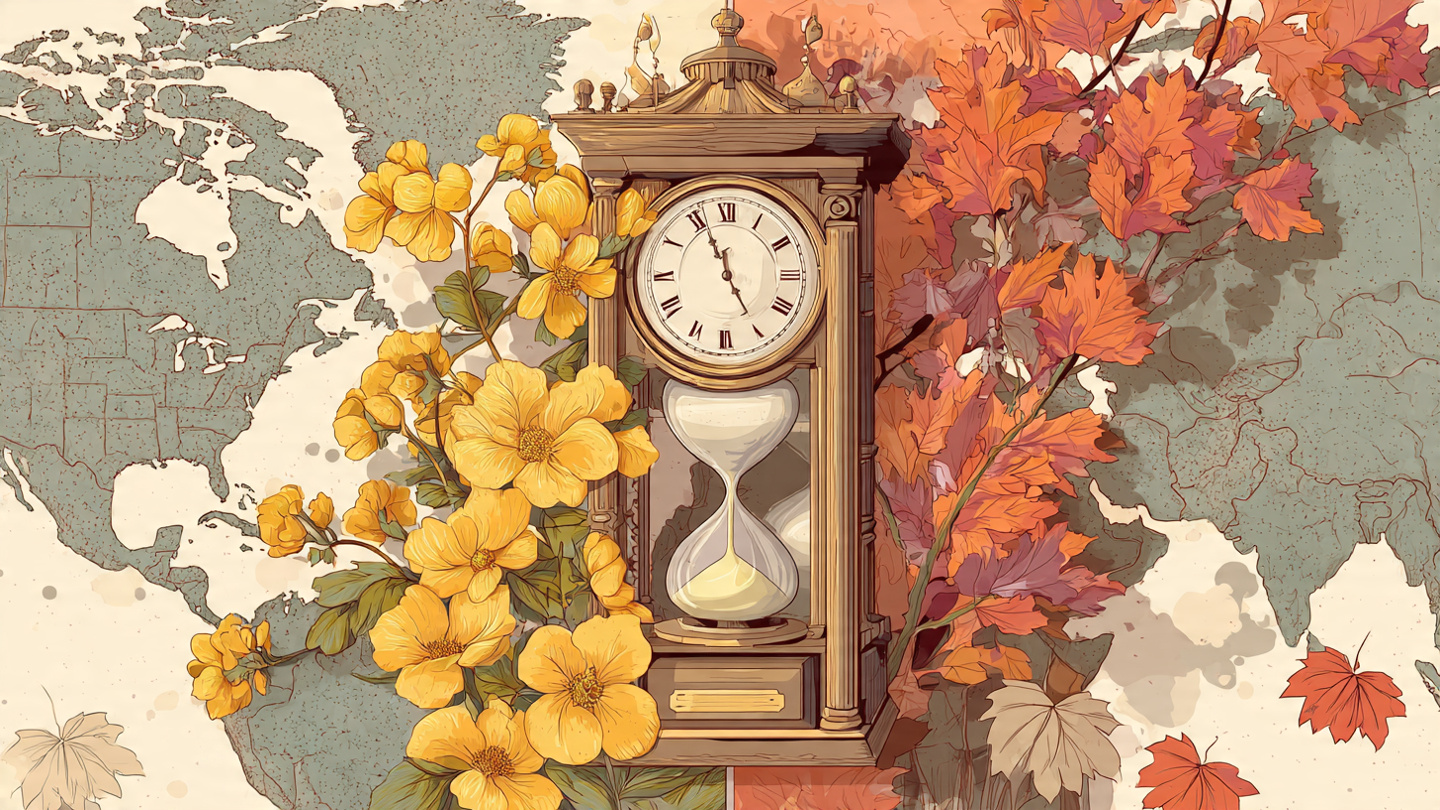
⏰ Guess what? Twice every year, the clocks change!
In the spring, someone sneaks in at night and steals ONE WHOLE HOUR from your morning. Poof! Gone! But do not worry. They hid it in the evening so you get extra sunshine to play outside! ☀️🌸
Then in the fall, you get your hour BACK! The clocks go backward, and you get to sleep a tiny bit longer. Yay! 🍂😴
This is called Daylight Saving Time! People do it because they wanted more sunshine after school and after work.
But here is a funny thing: not everybody does it! Some places, like Hawaii, said "No thanks, we have plenty of sunshine already!" 🌺
And guess who first thought of the idea? A man who LOVED collecting bugs! He wanted extra sunlight in the evening so he could hunt for more insects! 🐛🔍
What Is Daylight Saving Time?
Twice a year, we change our clocks. In the spring, we move them forward one hour. This is called "spring forward." In the fall, we move them back one hour. This is called "fall back." Together, this is called Daylight Saving Time, or DST for short.
Why Do We Do It?
The idea is to move an hour of daylight from the morning (when many people are still sleeping) to the evening (when people want to play outside or do things after work). It does not actually create extra sunlight. The sun does not care what our clocks say! It just changes when we wake up and go to bed compared to when the sun rises and sets.
Who Thought of This?
A long time ago, in 1895, a man from New Zealand named George Hudson had a very cool hobby: he collected insects! He wanted more daylight after his regular job so he could go outside and find bugs. So he wrote a paper suggesting that everyone move their clocks forward two hours in summer. People thought he was a little weird at first, but eventually the idea caught on!
Does Everyone Do It?
Nope! Hawaii and most of Arizona do not change their clocks at all. Most countries near the equator (the middle of the Earth) skip it too, because their days are already about the same length all year. Only about 70 countries use daylight saving time.
When Does It Happen?
In the United States, we spring forward on the second Sunday in March and fall back on the first Sunday in November. So every March, you lose an hour of sleep, and every November, you get it back!
The Bug Collector Who Changed Time
In 1895, a New Zealand postal worker and insect collector named George Vernon Hudson had a problem. After his shift at the post office, he wanted to go outside and collect bugs, but the sun set too early. His solution? Just move the clocks! He presented a paper to the Royal Society of New Zealand suggesting a two-hour clock shift in summer. The scientists listened politely, laughed a little, and filed it away. But Hudson was ahead of his time (pun intended).
Independently, a British builder named William Willett came up with the same idea in 1907 after noticing how many people slept through beautiful summer mornings. He spent his own money printing a pamphlet called "The Waste of Daylight" and lobbied the British Parliament for years. Willett died in 1915, one year before Britain finally adopted his idea.
Actually, Benjamin Franklin Thought of It First (Sort Of)
Way back in 1784, Benjamin Franklin was living in Paris as the American ambassador to France. He wrote a funny letter to a newspaper suggesting that Parisians could save money on candles if they just woke up earlier. He was joking! He even suggested firing cannons at sunrise to wake everyone up. But people have been crediting him with "inventing" daylight saving time ever since, even though he never actually suggested changing clocks.
Wars Made It Real
Germany became the first country to actually use daylight saving time on April 30, 1916, during World War I. The idea was simple: if people used more natural sunlight, they would burn less coal for lighting, and that coal could go to the war effort instead. Britain, France, and the United States quickly followed. After the war ended, most countries dropped it because people hated it. Then World War II started, and it came back again.
The Chaos Before the Rules
After World War II, there were no national rules about daylight saving time in the United States. Each city and state could choose whether to observe it or not. This created total chaos. In one year, a 35-mile bus ride from Steubenville, Ohio to Moundsville, West Virginia passed through SEVEN time changes! Radio and TV stations, airlines, and bus companies were going crazy trying to keep schedules straight.
Finally, in 1966, Congress passed the Uniform Time Act, which said that any state observing DST had to follow the same dates. States could still opt out entirely (Hawaii and most of Arizona did), but they could not make up their own schedule anymore.
Does It Actually Save Energy?
That was the original idea, but modern studies say: not really. A big study in Indiana after they adopted DST in 2006 found that electricity use actually went UP by about 1%, because even though people used less lighting in the evening, they used more air conditioning. Oops.
The Farmer Myth
A lot of people think farmers wanted daylight saving time. Actually, the opposite is true! Farmers were some of the biggest opponents of DST. Cows do not care what the clock says. They want to be milked at the same time every day. Crops need dew to dry before harvesting, and dew dries based on the sun, not the clock. The farming lobby fought against DST for decades.
Origins: Bugs, Candles, and Coal
Three people deserve credit (or blame) for daylight saving time, and none of them were farmers. George Vernon Hudson, a New Zealand entomologist, proposed a two-hour summer clock shift to the Royal Society of New Zealand in 1895 because he wanted more afternoon daylight for collecting insects. William Willett, a British builder, independently proposed the idea in a 1907 pamphlet called "The Waste of Daylight" after riding his horse through London at dawn and observing that most residents were still asleep. And Benjamin Franklin gets perpetual (unearned) credit for a satirical 1784 letter to the Journal de Paris suggesting that Parisians wake up earlier to save on candle costs. Franklin proposed no clock changes and was clearly joking (his suggested enforcement methods included taxing shutters and rationing candles), but the myth stuck.
The actual implementation came from war. Germany adopted DST on April 30, 1916, to conserve coal during World War I. Britain followed three weeks later, and the United States joined in 1918 with the Standard Time Act, which established both time zones and daylight saving time. The post-war backlash was immediate: DST was repealed nationally in 1919, with only a few cities (notably New York) choosing to keep it.
The Chaos Years (1945-1966)
After World War II, there was no federal DST law. Every state, county, and city could choose independently. The result was a scheduling disaster. At one point, 23 different start and end dates for DST existed simultaneously across the country. The Interstate Commerce Commission estimated that the time confusion cost airlines and railroads millions of dollars annually. A 35-mile bus route between Steubenville, Ohio and Moundsville, West Virginia passed through seven time changes.
The Uniform Time Act of 1966 finally imposed order. States that chose to observe DST had to follow uniform dates. States could opt out entirely but could not create their own schedules. Arizona (except the Navajo Nation, which does observe DST) and Hawaii opted out permanently.
Health Effects: More Serious Than You Think
The spring-forward transition is genuinely dangerous. Studies have documented a 24% increase in heart attacks on the Monday after clocks spring forward, compared to other Mondays. Fatal car crashes increase by approximately 6% in the week following the spring transition. Workplace injuries spike. Judges hand out harsher sentences on the Monday after losing an hour (yes, this has been studied). Even suicide rates show a temporary uptick.
The core problem is circadian disruption. Your body's internal clock is synchronized to sunlight, not to what the clock on your wall says. When the clock suddenly jumps an hour, your brain takes days or even weeks to fully adjust. It is essentially forced jet lag imposed on an entire population simultaneously. Sleep researchers consider the spring transition particularly harmful because it shortens an already-short winter night.
The Energy Savings Myth
DST was adopted to save energy, but modern research suggests the savings are tiny or nonexistent. A 2008 study by economists Matthew Kotchen and Laura Grant examined Indiana's statewide DST adoption in 2006 (a natural experiment, since Indiana had been split before) and found that DST actually increased residential electricity consumption by 1 to 4%, with the extra cost totaling approximately $9 million per year. The reason: reduced lighting demand was more than offset by increased air conditioning use in the longer, hotter evenings.
A 2017 meta-analysis in the journal Energy Policy, examining 44 studies across multiple countries, found average energy savings of just 0.34%, and even that small figure was not statistically significant in many studies. The original logic (save candle wax and coal) made sense in 1916, but modern energy consumption patterns are dominated by heating, cooling, and electronics, none of which respond meaningfully to clock changes.
Who Does NOT Observe DST?
Most of the world skips DST entirely. Only about 70 of the world's roughly 195 countries observe it. Countries near the equator have roughly equal day and night lengths year-round, so shifting the clock would be pointless. Hawaii has a similar justification: its latitude means day length varies by only about 2.5 hours between summer and winter. Arizona opted out because adding an extra hour of summer sunshine when temperatures already reach 115°F is nobody's idea of a good time.
The European Union voted in 2019 to abolish DST, but member states could not agree on whether to stay on permanent summer time or permanent winter time, so the directive stalled and has never been implemented.
The Sunshine Protection Act
In March 2022, the U.S. Senate unanimously passed the Sunshine Protection Act, which would have made DST permanent year-round (meaning clocks would never fall back). The bill was championed by Senator Marco Rubio of Florida. It passed the Senate by unanimous consent, partly because most senators were not paying attention and did not realize what they were voting on. The House of Representatives never voted on it, and the bill died.
Sleep scientists actually oppose permanent DST. They argue that if any time should be permanent, it should be standard time, because morning light is critical for synchronizing the circadian clock. Permanent DST would mean dark winter mornings until 8:30 or 9:00 AM in much of the country, which is bad for school-age children in particular.
The Three Inventors (and the One Who Was Joking)
Benjamin Franklin's 1784 letter to the Journal de Paris is perpetually cited as the origin of daylight saving time, but Franklin proposed nothing of the sort. His letter, titled "An Economical Project for Diminishing the Cost of Light," calculated that Parisians could save 64 million pounds of candle wax annually by waking at sunrise. His suggested enforcement mechanisms included taxing window shutters, rationing candle purchases, and firing cannons in every street at dawn. The letter was clearly satirical, a genre Franklin employed frequently, but it has been stripped of irony in countless "history of DST" articles ever since.
The actual credit belongs to George Vernon Hudson, a New Zealand entomologist who presented a paper to the Royal Society of New Zealand in 1895 proposing a two-hour summer clock advance. Hudson's motivation was straightforward: he wanted post-work daylight for insect collecting. The Royal Society received his paper with "interest" but took no action. Independently, William Willett published his pamphlet "The Waste of Daylight" in 1907 and spent years lobbying Parliament. A bill was introduced in 1909 but defeated. Willett died of influenza in 1915 at age 58, thirteen months before Britain adopted Summer Time in May 1916.
Wartime Adoption and Peacetime Backlash
Germany enacted Sommerzeit on April 30, 1916, making it the first country to implement daylight saving time. The explicit goal was coal conservation for the war effort. Britain followed on May 21, 1916, with the Summer Time Act. The United States adopted DST on March 19, 1918, through the Standard Time Act, which simultaneously established time zones and a summer clock advance.
The American backlash was immediate and fierce. Farmers led the opposition, not because they wanted to wake up later (they were already awake at dawn) but because DST disrupted their relationship with markets. Dairy farmers faced particular hardship: cows produce milk on a biological schedule that ignores clocks, so DST forced farmers to deliver milk an hour "later" relative to market opening times. The agricultural lobby successfully pushed repeal in 1919, overriding President Wilson's veto.
During World War II, President Roosevelt imposed year-round DST from February 1942 to September 1945, calling it "War Time." After the war, the country reverted to the state-by-state chaos that persisted until the Uniform Time Act of 1966.
The Epidemiology of Clock Changes
The health consequences of the spring-forward transition are well documented in the medical literature. A 2014 study in Open Heart, analyzing Michigan hospital admissions, found a 24% increase in acute myocardial infarction (heart attack) on the Monday following the spring transition compared to other Mondays, with the effect concentrated in people who were already at elevated cardiovascular risk. A 2020 meta-analysis in Sleep Medicine Reviews, aggregating data from seven studies and over 115,000 cases, confirmed a statistically significant increase in cardiovascular events in the days immediately following the spring clock change.
Traffic fatalities also spike. A 2020 study in Current Biology by Austin Smith at the University of Colorado examined 21 years of fatal crash data from the Fatality Analysis Reporting System and found a 6.3% increase in fatal traffic accidents in the week following the spring transition, translating to approximately 28 additional deaths per year in the United States. The effect was concentrated in the morning hours, consistent with sleep deprivation as the mechanism.
Additional documented effects include increased workplace injuries (a 2009 Journal of Applied Psychology study found a 5.7% increase and a 67.6% increase in work days lost to injuries on the post-spring-forward Monday), more emergency department visits, and disrupted medication timing for patients on time-sensitive regimens. The fall-back transition, by contrast, shows minimal negative effects and may slightly reduce heart attack risk in the days following the extra hour of sleep.
Energy Savings: The Data
The economic justification for DST has largely evaporated. The most rigorous natural experiment is Indiana's 2006 statewide adoption. Before 2006, 77 of Indiana's 92 counties did not observe DST, creating a natural control group. Economists Matthew Kotchen and Laura Grant (Review of Economics and Statistics, 2011) found that DST increased residential electricity consumption by approximately 1%, costing Indiana households roughly $9 million annually, with an additional $1.7 to $5.5 million in social costs from increased pollution. The mechanism is simple: reduced evening lighting was more than offset by increased air conditioning demand in the warmer, sunlit evenings.
A comprehensive meta-analysis by Havranek, Herman, and Irsova (Energy Policy, 2018) examined 44 studies across 10 countries and found average electricity savings of 0.34%, with high heterogeneity and many studies finding no significant effect. The U.S. Department of Energy's own 2008 report, mandated by the Energy Policy Act of 2005 (which extended DST by four weeks), found savings of approximately 0.03% of total annual electricity consumption. At that scale, DST does not meaningfully contribute to energy policy.
The Legislative Landscape
The Sunshine Protection Act passed the U.S. Senate by unanimous consent on March 15, 2022. Unanimous consent is a procedural mechanism in which a bill passes unless any senator objects; in this case, most senators were unaware the vote was occurring. The bill, sponsored by Marco Rubio (R-FL), would have made DST permanent starting November 2023. The House never brought it to a vote, and the bill expired with the 117th Congress.
The American Academy of Sleep Medicine (AASM), the Society for Research on Biological Rhythms, and most circadian scientists oppose permanent DST. Their position, published as a formal statement in the Journal of Clinical Sleep Medicine (2020), recommends permanent standard time. The reasoning is rooted in chronobiology: morning light is the primary synchronizer (zeitgeber) of the human circadian system. Permanent DST would delay sunrise by an hour relative to the current winter schedule, meaning sunrises after 8:30 AM in cities like Detroit, Indianapolis, and Boise from late November through early February. Dark mornings suppress the cortisol awakening response, delay melatonin offset, and are associated with increased seasonal affective disorder. Standard time aligns clocks more closely with solar noon, which places the sun at its highest point near 12:00 PM rather than 1:00 PM, better synchronizing biological and social time.
As of 2026, 22 U.S. states have passed legislation or resolutions to make DST permanent, but they cannot act without federal authorization. The Uniform Time Act allows states to opt out of DST (staying on permanent standard time) but does not allow them to opt in to year-round DST without an act of Congress.
The Software Problem
Clock changes create persistent headaches for software developers. The Internet Assigned Numbers Authority (IANA) maintains the "tz database," an open-source database of every time zone rule change in history, and it is updated multiple times per year as countries modify their DST rules (often with little warning). A 2007 change to DST start and end dates in the United States required patches to millions of devices, and countries like Egypt, Morocco, and Turkey have changed their DST rules with as little as two weeks' notice, leaving software developers scrambling.
The problem compounds in systems that schedule events across time zones, record timestamps for medical or legal purposes, or manage transportation timetables. Every airline schedule, hospital medication system, and financial trading platform must account for the biannual discontinuity. The spring-forward transition creates a "missing hour" (2:00 AM jumps to 3:00 AM, so times like 2:30 AM do not exist), while the fall-back transition creates a "repeated hour" (1:00 AM to 2:00 AM occurs twice, so timestamps in that window are ambiguous). Both scenarios have caused real bugs in production systems worldwide.
Historical Origins and Persistent Mythology
The popular attribution of daylight saving time to Benjamin Franklin is a misreading of a satirical letter. Franklin's 1784 piece in the Journal de Paris, written during his tenure as American Minister to France, calculated that Parisians could save 64,050,000 livres tournois on candle wax by waking at sunrise. His enforcement proposals (cannon fire at dawn, shutters taxed, candle rationing) were deliberately absurd. Franklin proposed no clock manipulation; the satirical genre was characteristic of his later writing. The persistent misattribution reflects the tendency of institutional histories to retroactively claim famous sponsors.
The substantive proposal came from George Vernon Hudson (1867-1946), a New Zealand entomologist employed as a postal clerk, who presented his paper "On Seasonal Time-Adjustment in Countries South of Lat. 30°" to the Royal Society of New Zealand in 1895. Hudson's two-hour shift proposal was published in the Transactions and Proceedings of the Royal Society of New Zealand but generated minimal response. Independently, William Willett (1856-1915), a prosperous English builder, published "The Waste of Daylight" (1907), proposing four 20-minute advances on successive Sundays in April, reversed in September. Willett's pamphlet was distributed at his personal expense and attracted parliamentary attention: a bill was introduced in 1908, debated intermittently, and defeated. Willett died in February 1915, having spent over £3,000 (roughly £400,000 in current purchasing power) on his campaign.
Wartime Implementation and the Agricultural Backlash
The German Empire enacted Sommerzeit effective April 30, 1916, by decree of the Bundesrat, explicitly to conserve coal for the war effort. Austria-Hungary followed the same day. The British Summer Time Act received Royal Assent on May 17, 1916. The United States adopted DST through the Standard Time Act of March 19, 1918, which simultaneously codified the four continental time zones established informally by the railroads since 1883.
The American agricultural lobby's opposition to DST is frequently misrepresented. The common narrative positions farmers as DST's originators or beneficiaries; the historical record shows the opposite. The National Grange, the American Farm Bureau Federation, and livestock associations actively lobbied against DST. Dairy operations were particularly disrupted: bovine lactation cycles are governed by circadian biology, not clock time, so a one-hour clock advance forced farmers to either disrupt milking schedules (reducing yield) or deliver milk an hour later relative to market operations and railroad pickup times. The agricultural lobby successfully pushed DST repeal through Congress in August 1919, overriding President Wilson's veto. DST persisted only in some municipalities (New York City maintained it continuously from 1920 onward) until federal reimposition during World War II.
The Uniform Time Act and Its Exceptions
The post-WWII fragmentation of American timekeeping produced the scheduling chaos that eventually forced federal intervention. A Transportation Association of America study documented 23 distinct DST start and end date combinations across U.S. localities. The Interstate Commerce Commission reported that bus companies, railroads, and airlines were spending millions annually on schedule revisions and passenger confusion. The 35-mile bus route between Steubenville, Ohio and Moundsville, West Virginia traversed seven time changes, a fact cited repeatedly in congressional testimony.
The Uniform Time Act of 1966 (15 U.S.C. §§ 260-267) established uniform DST dates (last Sunday of April to last Sunday of October) for all states that chose to observe it. States could exempt themselves entirely by state legislature action but could not create custom schedules. Arizona (except the Navajo Nation) and Hawaii have maintained permanent standard time since 1968 and 1967 respectively. The Energy Policy Act of 2005 extended DST by four weeks (to the second Sunday of March and first Sunday of November), effective 2007.
Cardiovascular and Mortality Evidence
The epidemiological evidence for acute cardiovascular risk following the spring transition has accumulated across multiple independent datasets. Janszky and Ljung (2008) found a statistically significant increase in acute myocardial infarction incidence during the first week of the spring transition using the Swedish Myocardial Infarction Register (N = 110,469 AMIs, 1987-2006). Sandhu et al. (2014) reported a 25% increase in AMI admissions on the Monday following the spring transition using Michigan Blue Cross Blue Shield data. Sipilä et al. (2016) found a similar pattern in Finland. A 2020 meta-analysis in Sleep Medicine Reviews (Manfredini et al.) aggregated seven studies totaling over 115,000 events and confirmed a pooled relative risk of 1.05 (95% CI: 1.02-1.07) for cardiovascular events in the spring transition period.
The fatal traffic accident data is equally stark. Smith (2016, Current Biology) analyzed 21 years of FARS data (732,835 fatal crashes) and found a 6.3% increase in the week following the spring transition, with the effect concentrated in the morning hours and western portions of time zones (where the sun rises later even before DST). Robb and Barnes (2018) estimated approximately 28 additional fatal crashes per year attributable to the spring transition, totaling roughly 300 deaths over the study period.
Additional documented effects include a 5.7% increase in workplace injuries and a 67.6% increase in workdays lost to injuries on the post-spring-forward Monday (Barnes and Wagner, 2009, Journal of Applied Psychology); increased rates of ischemic stroke in the 48 hours following the spring transition (Sipilä et al., 2016); and disrupted medication adherence for patients on anticoagulant therapy, with some pharmacovigilance databases showing detectable shifts in INR (international normalized ratio) values in the days following clock changes.
The Energy Economics
The Indiana natural experiment provides the cleanest causal evidence. Before Indiana's 2006 statewide adoption, 77 of 92 counties did not observe DST, enabling difference-in-differences estimation against counties that had always observed it. Kotchen and Grant (Review of Economics and Statistics, 2011) found a 1% increase in residential electricity demand (p < 0.05), driven entirely by air conditioning. Monetized, the increase cost Indiana residential consumers approximately $9 million annually, with social costs of pollution adding $1.7 to $5.5 million. The finding is not paradoxical once you recognize that the 1916 energy mix was dominated by lighting (coal gas, candles, incandescent bulbs), while the modern mix is dominated by HVAC and electronics.
The Havranek, Herman, and Irsova meta-analysis (Energy Policy, 2018) applied Bayesian model averaging to 162 estimates from 44 studies across 10 countries and found a publication-bias-corrected mean electricity savings estimate of essentially zero. The U.S. DOE's own mandated 2008 assessment found savings of 1.3 TWh per year (0.03% of total consumption), a figure within the margin of measurement error for the national grid.
Chronobiological Arguments Against Permanent DST
The American Academy of Sleep Medicine's 2020 position paper, published in the Journal of Clinical Sleep Medicine and endorsed by 20 medical and scientific organizations including the Society for Research on Biological Rhythms and the National Sleep Foundation, explicitly recommends permanent standard time over permanent DST. The chronobiological reasoning centers on the zeitgeber function of morning light: exposure to sunlight shortly after waking suppresses melatonin, initiates the cortisol awakening response, and entrains the suprachiasmatic nucleus (the brain's master clock) to the solar day. Permanent DST would delay sunrise by approximately 60 minutes relative to current winter standard time, producing post-8:30 AM sunrises for roughly 10 weeks in cities at the western edge of their time zones (Detroit: 9:00 AM sunrise, December-January; Boise: 8:57 AM; Indianapolis: 9:05 AM).
Russia provides a cautionary example. Russia adopted permanent summer time (equivalent to permanent DST) in 2011 under President Medvedev. The resulting dark winter mornings proved so unpopular and physiologically disruptive that Russia switched to permanent standard time in 2014, a reversal that required legislative action. The experience is frequently cited by chronobiologists as evidence that permanent DST creates a larger mismatch between social time and solar time than the clock changes it was intended to eliminate.
Current Legislative Status
The Sunshine Protection Act (S. 623, 117th Congress) passed the Senate by unanimous consent on March 15, 2022. The procedural mechanism bears examination: unanimous consent requires that no senator object. The bill was called for a vote when few senators were on the floor, and several later expressed surprise that it had passed. Senator Tom Cotton (R-AR) publicly stated he would have objected had he been present. The House never brought the companion bill (H.R. 69) to a vote, and the legislation expired at the end of the 117th Congress.
As of 2026, the federal Uniform Time Act remains unchanged. States may opt out of DST (permanent standard time) without federal action, but adopting permanent DST requires congressional authorization. Twenty-two states have passed legislation or resolutions expressing intent to make DST permanent, contingent on federal approval. The fundamental tension persists: the public broadly favors "more evening light" (permanent DST) while sleep scientists unanimously favor "aligned morning light" (permanent standard time), and Congress has shown no appetite to resolve the disagreement.
Sources
1. Benjamin Franklin, "An Economical Project for Diminishing the Cost of Light," Journal de Paris, April 26, 1784.
2. George Vernon Hudson, "On Seasonal Time-Adjustment in Countries South of Lat. 30°," Transactions and Proceedings of the Royal Society of New Zealand, Vol. 28, 1895.
3. William Willett, "The Waste of Daylight" (self-published pamphlet, 1907).
4. Matthew J. Kotchen and Laura E. Grant, "Does Daylight Saving Time Save Energy? Evidence from a Natural Experiment in Indiana," Review of Economics and Statistics 93(4), 2011.
5. Tomas Havranek, Dominik Herman, and Zuzana Irsova, "Does Daylight Saving Save Electricity? A Meta-Analysis," Energy Policy 118, 2018.
6. Austin C. Smith, "Spring Forward at Your Own Risk: Daylight Saving Time and Fatal Vehicle Crashes," American Economic Journal: Applied Economics 8(2), 2016.
7. Amneet Sandhu et al., "Daylight Saving Time and Myocardial Infarction," Open Heart 1(1), 2014.
8. Christopher M. Barnes and David T. Wagner, "Changing to Daylight Saving Time Cuts Into Sleep and Increases Workplace Injuries," Journal of Applied Psychology 94(5), 2009.
9. Imre Janszky and Rickard Ljung, "Shifts to and from Daylight Saving Time and Incidence of Myocardial Infarction," New England Journal of Medicine 359(18), 2008.
10. American Academy of Sleep Medicine, "Position Statement: Abolition of Daylight Saving Time," Journal of Clinical Sleep Medicine 16(6), 2020.