
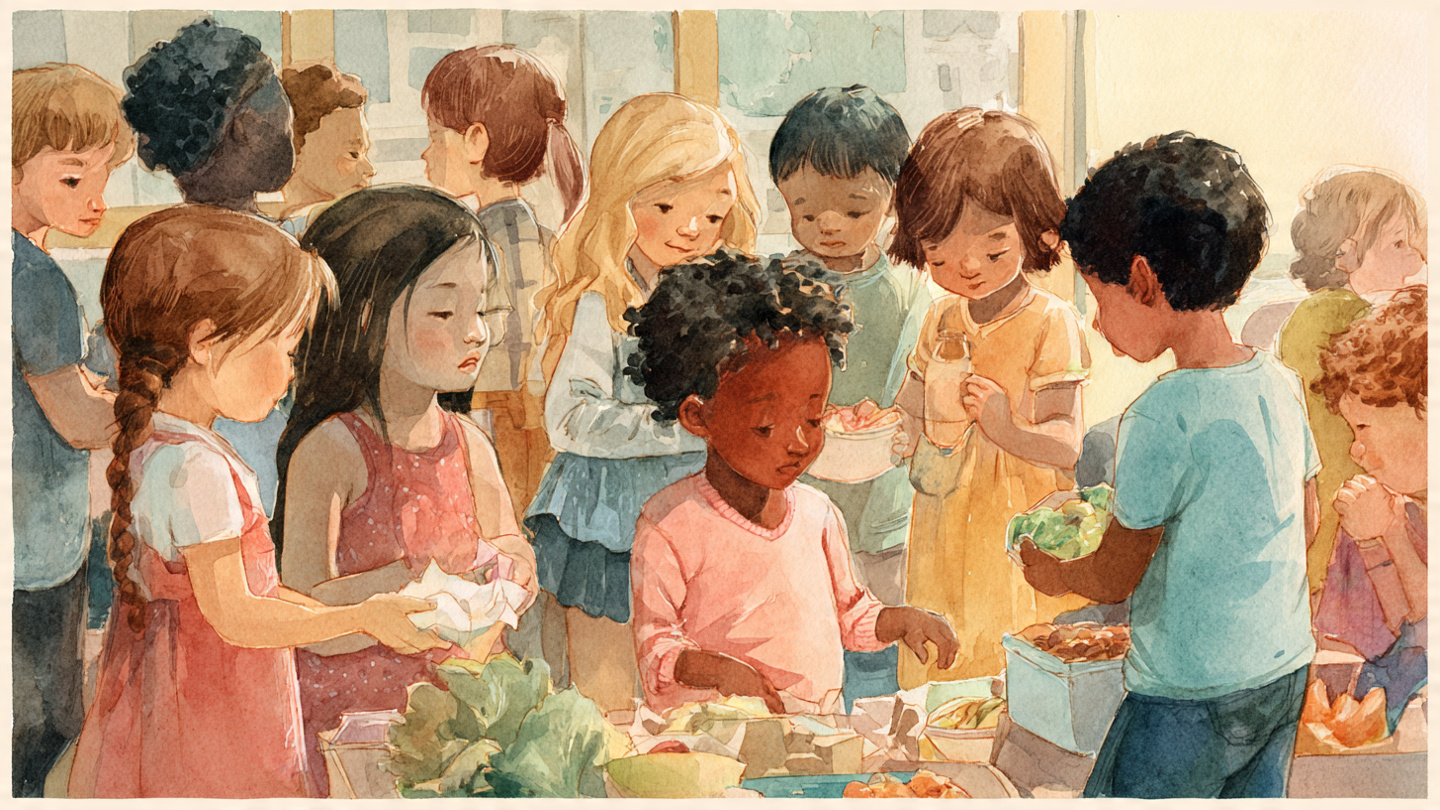
There is a SUPER special school in San Francisco! 🌍
🎨👫🌈
Kids from ALL over the world go there! They paint together! They sing together! They read and play together!
Some kids speak Spanish. Some speak Chinese. Some speak Japanese! SO many languages! 🗣️
And the FOOD! One day you might try dumplings. The next day, tamales! YUM! 🥟🫔
🏠❤️
Families help too! Grandmas and grandpas come to school and teach about where they come from. A grandma might show how to fold paper into a bird! 🦢
It is called the Cross Cultural Family Center. "Cross cultural" means mixing all the BEST parts from everywhere! Everyone is welcome! 🌎💛
In San Francisco, there is a school called the Cross Cultural Family Center. It is at 1347 Pierce Street, in a neighborhood full of all kinds of people. 🏘️
🌍🎶📚
Kids at this school come from many different countries. Some speak Spanish at home. Some speak Mandarin. Some speak Tagalog or Russian or Japanese. At this school, that is something to be proud of! 🗣️
The teachers plan activities where kids share things from their families. You might taste dumplings one day and tamales the next! 🥟🫔
👨👩👧👦
Families are a big part of the school. Parents and grandparents visit and teach the class about holidays, music, and traditions from their cultures.
"Cross cultural" means learning from each other's backgrounds. When you understand how someone else lives, you become a better friend. 💛
The Cross Cultural Family Center is an early childhood education center in San Francisco's Western Addition neighborhood, at 1347 Pierce Street. It has been serving families in one of the city's most diverse communities for decades.
What Does "Cross Cultural" Mean?
Imagine a classroom where one kid's family is from Mexico, another's is from China, another's is from the Philippines, and another's is from Russia. Instead of pretending everyone is the same, this school celebrates what makes each family different. Kids learn words in each other's languages. They taste each other's foods. They hear each other's stories.
What Do They Do There?
The center serves young children, mostly ages 2 through 5, with programs built around play, creativity, and social skills. Teachers use art, music, cooking, and storytelling to help kids learn, and they weave in cultural elements from the families in the room.
A big part of the program is family involvement. Parents and grandparents are invited into the classroom regularly. A grandmother might teach the class how to fold origami. A father might bring in a guitar and play songs from his childhood in Guatemala.
Why Does It Matter?
Research shows that when young children learn about other cultures, they develop stronger empathy and social skills. They also feel more confident about their own identity. When a kid sees their home language and traditions valued at school, it sends a powerful message: who you are matters here.
San Francisco is one of the most diverse cities in the United States. About 35% of residents were born in another country. The Cross Cultural Family Center reflects that reality and turns it into a strength.
The Cross Cultural Family Center (CCFC) operates out of 1347 Pierce Street in San Francisco's Western Addition, a neighborhood whose demographic composition reads like a miniature United Nations. The center provides early childhood development services with an explicit cross-cultural framework.
The Educational Approach
CCFC's pedagogy draws on several established early childhood education frameworks. Elements of the Reggio Emilia approach appear in the emphasis on child-led exploration and the "environment as third teacher" concept. The center arranges spaces to reflect the cultures of enrolled families, with multilingual signage, culturally diverse art materials, and music from around the world.
Play-based learning forms the backbone. Rather than drilling worksheets, children build social and cognitive skills through structured and unstructured play. A child negotiating who gets the red crayon is actually practicing conflict resolution, perspective-taking, and communication.
Multilingual Environments
San Francisco's linguistic diversity is staggering. The city's public schools serve students who speak over 50 different home languages. CCFC creates what researchers call an "additive bilingual environment," where a child's home language is treated as an asset, not a problem to fix.
This matters because research from the National Academies of Sciences (2017) found that children in additive bilingual programs showed stronger executive function, the brain's ability to focus, switch tasks, and hold information in working memory. These skills predict academic success more reliably than early reading ability.
Community-Based Education
CCFC operates on a community-based model, meaning it is embedded in and accountable to the neighborhood it serves. This differs from chain preschools or large institutional programs. Community-based centers typically maintain smaller enrollments, deeper family relationships, and programming that adapts to local needs.
The tradeoff is resources. Community-based programs often operate on tighter budgets than corporate chains. They depend on a mix of state subsidies, federal Head Start funding, parent fees, and private grants. This funding patchwork makes them vulnerable to policy shifts but also keeps them responsive to community priorities.
The Western Addition Context
The Western Addition has one of the most complex demographic histories in San Francisco. It was historically a center of African American culture, home to jazz clubs and community institutions. Waves of urban renewal, gentrification, and immigration have transformed it into one of the city's most ethnically layered neighborhoods. CCFC's mission to serve cross-cultural families directly reflects this particular place and its particular history.
The Cross Cultural Family Center sits at the intersection of several significant threads in early childhood education research: culturally responsive pedagogy, community-based program design, and the cognitive benefits of multilingual environments.
Culturally Responsive Pedagogy
Geneva Gay's foundational framework (2010) defines culturally responsive teaching as using "the cultural knowledge, prior experiences, frames of reference, and performance styles of ethnically diverse students to make learning encounters more relevant and effective." CCFC operationalizes this at the earliest educational stage.
What makes this more than a feel-good mission statement is the emerging neuroscience. A 2015 study by Bialystok and Barac demonstrated that bilingual children showed enhanced inhibitory control and cognitive flexibility on the Dimensional Change Card Sort task compared to monolingual peers. The effect was most pronounced when both languages were actively used in educational settings, exactly the environment CCFC creates.
Code-Switching and Identity Formation
Children in cross-cultural environments develop sophisticated code-switching abilities early. Code-switching is not just linguistic (switching between Spanish and English mid-sentence). It is also cultural: adjusting behavior, communication style, and social norms depending on context.
Ofelia Garcia's concept of translanguaging reframes this as a cognitive strength rather than confusion. Children who translanguage are not "mixing up" their languages. They are deploying a unified linguistic repertoire strategically. Garcia argues that translanguaging classrooms, where multiple languages coexist and interact, produce more flexible thinkers.
For identity formation, the research is clear. Erikson's stages place early childhood as the period when children develop either autonomy and initiative or shame and doubt. When a child's cultural identity is affirmed in educational settings, they are more likely to develop a positive self-concept (Phinney, 1992). When their home culture is ignored or devalued, the opposite occurs.
Policy Implications
California's Transitional Kindergarten (TK) expansion, which by 2025-26 extends free public pre-K to all four-year-olds, raises an interesting question for programs like CCFC. Does universal TK help or threaten community-based centers?
The answer is complicated. Universal TK increases access, which is good. But it also diverts enrollment from community-based programs that may offer more culturally specific, family-centered approaches. A child attending a large public school TK program may gain academic preparation but lose the intimate, culturally embedded environment a place like CCFC provides.
The National Institute for Early Education Research (NIEER) has noted that the highest-quality early childhood programs tend to be those with strong family engagement components, precisely what community-based models prioritize and large-scale public programs struggle to replicate.
The Cross Cultural Family Center at 1347 Pierce Street in San Francisco's Western Addition represents a model of early childhood education that is both increasingly relevant and increasingly endangered.
What CCFC Actually Does
CCFC provides child development services for young children (primarily ages 2-5) with an explicit cross-cultural framework. Their mission centers on three principles: developmental appropriateness, family partnership, and cultural responsiveness. In practice, this means classrooms where multiple languages are spoken, families actively participate in curriculum, and cultural heritage is treated as educational content rather than background noise.
The center operates in the Western Addition, one of San Francisco's most demographically complex neighborhoods. The area is home to families from Latin America, East Asia, Southeast Asia, Eastern Europe, and the African American community that has been there for generations. CCFC's enrollment typically reflects this diversity.
The Funding Landscape
Community-based early childhood programs like CCFC operate on a patchwork of funding: California Department of Education contracts (General Child Care, State Preschool), federal subsidies (Child Care and Development Fund), city-level grants (San Francisco's Office of Early Care and Education), parent fees on sliding scales, and occasional private philanthropy.
This model is inherently fragile. When state budgets tighten, community-based programs are often the first cut. San Francisco's cost of living adds pressure: teacher salaries must compete with a housing market where median rent exceeds $3,000/month, yet reimbursement rates from the state are pegged to statewide averages that don't account for Bay Area costs.
California's TK Expansion: Friend or Foe?
California's universal Transitional Kindergarten, fully phased in by 2025-26, offers free public pre-K to all four-year-olds. This is unambiguously good for access. But for community-based programs serving four-year-olds, it creates a competitive dynamic.
Parents choosing between free TK at a public school and a tuition-based (even subsidized) slot at CCFC may default to the free option. What they gain in cost savings they may lose in the cultural specificity, family intimacy, and multilingual depth that a community-based center provides. The research from NIEER consistently shows that program quality correlates most strongly with teacher qualifications and family engagement, both areas where small community-based programs often outperform larger institutional settings.
For Parents Considering CCFC
Location: 1347 Pierce Street, San Francisco (Western Addition, near Japantown)
What to ask about:
- Current enrollment availability and waitlist
- Subsidy eligibility (many families qualify for state or city subsidies that significantly reduce costs)
- Daily schedule and curriculum approach
- How family participation works in practice
- Language policies and how they support your child's home language
What makes it different: Unlike chain preschools (KinderCare, Bright Horizons) or public TK, CCFC is rooted in a specific community. The curriculum adapts to the families in the room, not the other way around. For families who want their child's cultural and linguistic background actively valued rather than merely tolerated, this distinction matters.
Website: crossculturalsf.org