
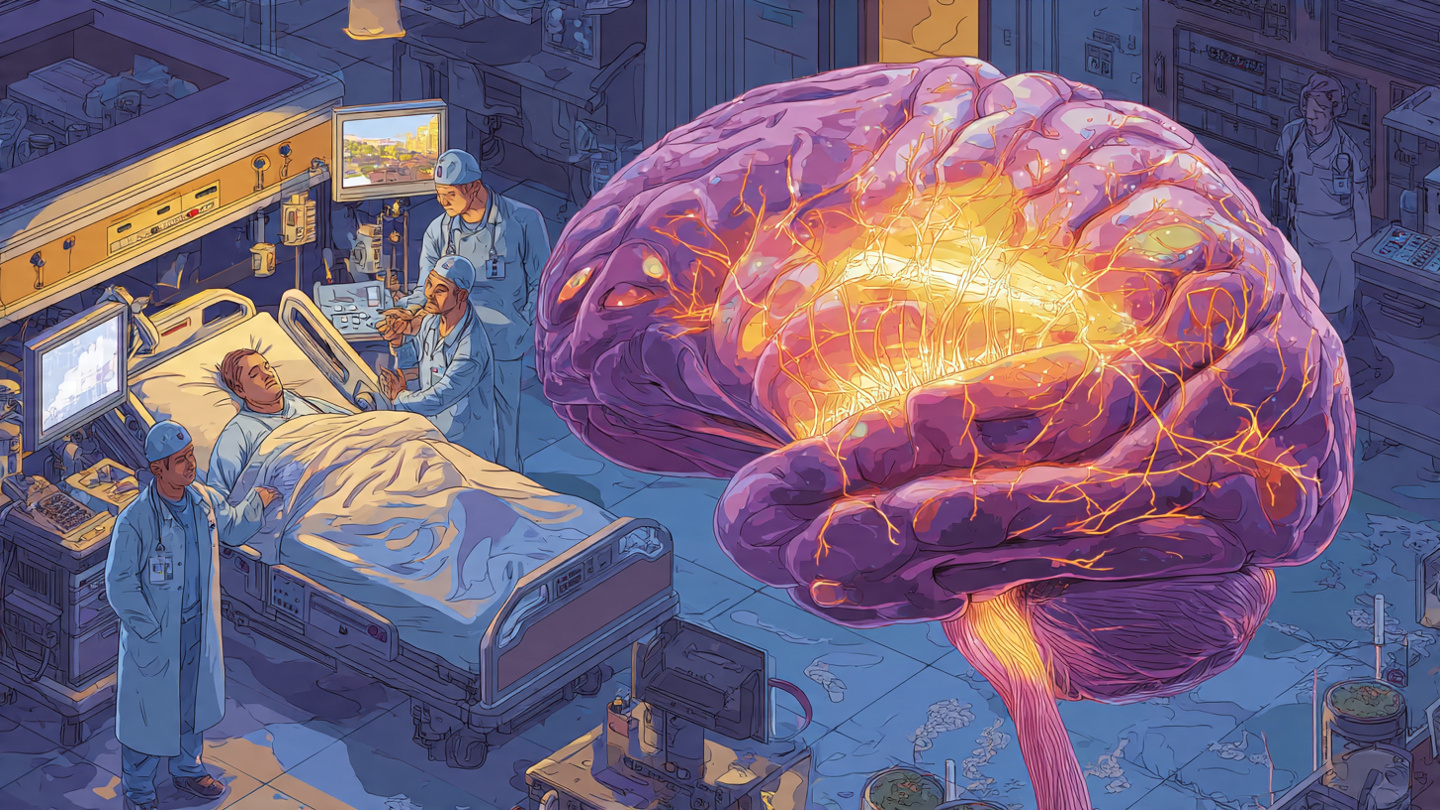
🧠😴
Sometimes a person gets very hurt or very sick. Their brain goes into a DEEP sleep. 💤
Doctors and nurses watch over them. They keep the person safe until the brain is ready to wake up. 👩⚕️💛
Many people DO wake up! Their families are so happy! 🎉
What Is a Coma?
A coma is when someone's brain goes into a very, very deep sleep. They cannot wake up on their own, even if you call their name or shake their arm.
Why Does It Happen?
It can happen if someone hits their head really hard or gets very sick. The brain is protecting itself, like shutting a door so it can rest and heal.
How Do Doctors Help?
Doctors use special machines to check on the sleeping person. They make sure the person gets food and water through tiny tubes. Nurses talk to the person because sometimes, even in a deep sleep, the brain can hear.
Do People Wake Up?
Yes! Many people wake up from comas. It can take days, weeks, or even longer. When they wake up, they need lots of help to get strong again. Their families cheer them on! 💪
What Is a Coma?
A coma is a state of deep unconsciousness. The person is alive, their heart beats, they breathe (sometimes with help from a machine), but they do not respond to sounds, light, or touch the way a sleeping person would. You cannot wake them up by shaking them or shouting.
What Causes a Coma?
Several things can cause a coma:
- Head injuries from car accidents or falls
- Strokes, when blood stops flowing to part of the brain
- Infections like meningitis that cause the brain to swell
- Very low blood sugar in people with diabetes
- Poisoning from chemicals or too much medicine
Sometimes doctors put a person into a coma on purpose using medicine. This is called a medically induced coma, and it helps the brain rest while it heals from a serious injury.
How Do Doctors Help?
In the hospital, coma patients go to the ICU (Intensive Care Unit). Machines track their heart rate, blood pressure, and brain activity. A breathing machine called a ventilator helps them breathe. Tubes deliver food and medicine directly into their body.
Waking Up
Waking up from a coma does not happen like in the movies, where a person sits up and starts talking. In real life, it is a slow process. The person might first start moving their fingers, then open their eyes for a few seconds, then gradually become more aware over days or weeks. Recovery takes patience, therapy, and lots of support from family.
About 50% of people who experience a coma from a head injury make a good recovery. Younger brains tend to recover better because they are still growing and can rewire more easily.
The Brain's Off Switch
A coma is not sleep. Sleep is an active, organized process with defined stages (REM, NREM) controlled by specific brain circuits. A coma occurs when the reticular activating system (RAS), a network of neurons in the brainstem responsible for maintaining wakefulness, is disrupted. Without the RAS sending "stay awake" signals to the cerebral cortex, consciousness shuts down.
Causes and Mechanisms
Comas fall into two broad categories based on mechanism:
- Structural damage: A physical injury disrupts brain tissue. Traumatic brain injury (TBI), hemorrhagic stroke, or tumors can compress the brainstem or damage the RAS directly.
- Metabolic/toxic disruption: The brain's chemistry goes wrong without physical damage. Hypoglycemia (low blood sugar), drug overdose, liver failure (hepatic encephalopathy), or severe infection can poison the neurons that maintain consciousness.
The Glasgow Coma Scale
Developed in 1974 by neurosurgeons Graham Teasdale and Bryan Jennett, the Glasgow Coma Scale (GCS) is the standard tool for measuring consciousness. It tests three responses:
- Eye opening: 1 (none) to 4 (spontaneous)
- Verbal response: 1 (none) to 5 (oriented conversation)
- Motor response: 1 (none) to 6 (obeys commands)
Medically Induced Comas
Doctors sometimes create comas intentionally using barbiturates or propofol. After severe brain injuries, the brain swells with inflammation. Swelling inside the rigid skull increases pressure (intracranial pressure, or ICP), which can cause further damage. By suppressing brain activity with drugs, doctors reduce the brain's metabolic demand, lowering ICP and giving the brain time to heal.
Recovery and the Spectrum of Consciousness
Consciousness is not binary. Between coma and full awareness, there are several states:
- Coma: No awareness, no sleep-wake cycles (usually lasts days to weeks)
- Vegetative state: Sleep-wake cycles return, eyes may open, but no purposeful responses
- Minimally conscious state (MCS): Inconsistent but definite signs of awareness (tracking objects with eyes, reaching for things)
- Full consciousness: Oriented, responsive, aware
Recovery depends heavily on the cause. Drug-induced comas often resolve completely once the substance clears. Traumatic brain injury comas have variable outcomes depending on the severity and location of damage. Age matters: children and young adults have significantly better recovery rates due to greater neuroplasticity, the brain's ability to form new connections around damaged areas.
Consciousness, Coma, and the Neuroscience of Awareness
The study of coma sits at the intersection of neurology, intensive care medicine, and one of the hardest problems in science: what is consciousness? A coma is operationally defined as a state of unresponsiveness in which the patient cannot be aroused, shows no purposeful motor activity, and has no evidence of awareness of self or environment. But "awareness" turns out to be far more complicated than it appears.
The Anatomy of Wakefulness
Consciousness requires two components: arousal (being awake) and awareness (perceiving and processing the environment). Arousal depends on the ascending reticular activating system (ARAS), a diffuse network of nuclei in the upper brainstem and diencephalon, including the locus coeruleus (norepinephrine), raphe nuclei (serotonin), pedunculopontine tegmentum (acetylcholine), and tuberomammillary nucleus (histamine). These nuclei project widely to the thalamus and cortex, maintaining the tonic excitatory state necessary for cortical processing.
Awareness depends on intact cortico-thalamic circuits, particularly the frontoparietal network. Damage to the ARAS eliminates arousal; damage to the cortex or thalamus can eliminate awareness while leaving arousal partially intact (the vegetative state).
The Glasgow Coma Scale and Its Limitations
The GCS (Teasdale and Jennett, 1974) remains the most widely used clinical tool, but it has significant limitations. It cannot distinguish between a patient in a vegetative state and one in a minimally conscious state (MCS). It is unreliable in intubated patients (verbal score becomes unmeasurable). And it conflates very different neurological pictures into the same numeric score.
The FOUR Score (Full Outline of UnResponsiveness, Wijdicks et al., 2005) was developed to address these limitations. It evaluates eye response, motor response, brainstem reflexes, and respiratory pattern, providing a more nuanced neurological assessment. Crucially, it can be used in intubated patients and includes brainstem reflex testing, which has stronger prognostic value than the GCS verbal component.
The Hidden Consciousness Problem
In 2006, Adrian Owen's team at Cambridge published a landmark study in Science. A patient diagnosed as vegetative was asked to imagine playing tennis and then to imagine walking through her house. fMRI showed distinct activation patterns in the supplementary motor area (tennis) and parahippocampal gyrus (navigation), identical to healthy controls. The patient was consciously processing commands despite showing no behavioral signs of awareness.
Subsequent studies using EEG-based paradigms have found that 15-20% of patients clinically diagnosed as vegetative show evidence of covert awareness. This has profound ethical implications: some patients who appear unconscious may be locked in, aware but unable to produce motor output.
Prognosis and Recovery
Prognostication in coma remains imperfect. The most reliable predictors for traumatic coma include:
- GCS motor score at 72 hours: Motor scores of 5-6 predict favorable outcomes in >85% of cases
- Pupillary reactivity: Bilateral fixed pupils at 72 hours predicts poor outcome in >95% of cases
- Somatosensory evoked potentials (SSEPs): Bilateral absence of N20 cortical responses predicts poor outcome with near-100% specificity
- EEG patterns: Burst-suppression or generalized suppression indicates severe cortical dysfunction
For non-traumatic comas, outcomes are generally worse. Anoxic brain injury (e.g., cardiac arrest) carries particularly poor prognosis, with only 7-10% of patients who remain comatose at 72 hours achieving functional independence.
However, the field is evolving. Targeted temperature management (therapeutic hypothermia) after cardiac arrest has improved outcomes significantly. Amantadine, a dopamine agonist, accelerated recovery in a randomized controlled trial of TBI patients in vegetative or minimally conscious states (Giacino et al., 2012, NEJM). And emerging approaches using transcranial direct current stimulation (tDCS) of the left dorsolateral prefrontal cortex have shown promise in small studies of MCS patients.
Coma: The Neuroscience, Clinical Reality, and Ethical Frontier
When Eliza submitted "coma" as a story request, it was worth pausing before hitting publish. This is heavy terrain for a kids' site. But coma is also a window into some of the most important questions in neuroscience: what consciousness is, how the brain maintains it, and what happens when it fails. Framed as science, it belongs here.
What a Coma Actually Is
A coma is a state of prolonged unconsciousness in which the patient cannot be aroused by any stimulus, including pain. It differs from sleep (which has organized cycles and from which a person can be roused), from syncope (transient loss of consciousness), and from brain death (irreversible cessation of all brain function including brainstem reflexes).
Clinically, coma is defined by a Glasgow Coma Scale score of 8 or below. But the GCS, developed by Teasdale and Jennett in 1974, was designed as a rapid bedside assessment for trauma patients, not a comprehensive consciousness measure. It cannot be scored in intubated patients (no verbal component), does not assess brainstem reflexes, and conflates fundamentally different neurological states into the same numeric range. The FOUR Score (Wijdicks et al., 2005) addresses some of these limitations by substituting brainstem reflex and respiratory pattern assessment for the verbal component.
The Reticular Activating System
Wakefulness depends on the ascending reticular activating system (ARAS), a collection of brainstem nuclei that project excitatory signals to the thalamus and cortex. Key nodes include the locus coeruleus (norepinephrine), dorsal raphe (serotonin), pedunculopontine and laterodorsal tegmental nuclei (acetylcholine), ventral tegmental area (dopamine), and tuberomammillary nucleus (histamine). General anesthetics work by suppressing these same circuits: propofol enhances GABAergic inhibition; ketamine blocks NMDA receptors in the thalamocortical loop.
The distinction between arousal and awareness is critical. A patient in a vegetative state has regained arousal (sleep-wake cycles, eyes open) but not awareness. A patient in a minimally conscious state shows inconsistent but reproducible evidence of awareness. These distinctions have enormous prognostic and ethical significance, and they are frequently misdiagnosed. Andrews et al. (1996) found a 43% misdiagnosis rate for the vegetative state in a UK rehabilitation setting.
The Covert Awareness Revolution
Adrian Owen's 2006 Science paper fundamentally changed the field. By asking a patient diagnosed as vegetative to perform mental imagery tasks during fMRI scanning, Owen demonstrated command-following, the gold standard for consciousness, in a patient who showed zero behavioral evidence of awareness. The patient activated supplementary motor cortex when asked to imagine playing tennis and parahippocampal place area when asked to imagine navigating her home, precisely matching healthy control patterns.
This was not an isolated finding. Cruse et al. (2011) replicated it using bedside EEG, a far more scalable technology than fMRI. Kondziella et al. (2020) conducted a meta-analysis of 29 studies (n = 730) and found that approximately 15-20% of patients clinically diagnosed as vegetative showed neuroimaging or electrophysiological evidence of covert awareness. The label "cognitive motor dissociation" (CMD) has emerged for this condition.
The implications are staggering. If one in five "vegetative" patients is covertly aware, decisions about withdrawing life support based on a vegetative state diagnosis carry a meaningful risk of ending the life of a conscious person. This finding has not yet fully permeated clinical practice, in part because fMRI and high-density EEG paradigms are not available in most hospitals, and in part because the ethical framework for acting on probabilistic consciousness evidence remains unsettled.
Medically Induced Comas
Therapeutic coma (more accurately, pharmacological burst suppression) is used primarily after severe traumatic brain injury or refractory status epilepticus. The rationale is metabolic: an active brain consumes approximately 3.5 mL of oxygen per 100g of tissue per minute. By suppressing neuronal firing with barbiturates (pentobarbital) or propofol, cerebral metabolic rate drops by 50-60%, reducing intracranial pressure and potentially limiting secondary injury.
The evidence base is thinner than most families realize. The 2019 Cochrane review on barbiturate coma for TBI (Roberts and Sydenham) found insufficient evidence of benefit on mortality or functional outcome. The practice continues because the physiological logic is sound and alternatives for refractory intracranial hypertension are limited, but it is not the slam-dunk intervention that popular depictions suggest.
Recovery
The single most useful study on recovery from coma is the Multi-Society Task Force on PVS, published in the New England Journal of Medicine in 1994. For traumatic causes: 52% of patients in a vegetative state at one month recovered consciousness within a year. For non-traumatic causes: only 15% recovered consciousness in the same timeframe, and functional outcomes were worse.
More recently, Giacino et al. (2012, NEJM) demonstrated that amantadine, a dopamine agonist, accelerated functional recovery in patients with traumatic disorders of consciousness during a 4-week randomized controlled trial. This remains the only Class I evidence for pharmacological intervention in prolonged disorders of consciousness.
Age matters profoundly. Pediatric coma outcomes are generally better than adult outcomes for equivalent injuries, reflecting greater neuroplasticity and more robust neurovascular repair mechanisms. This is relevant context for Cookie Club's audience: if a child ever encounters a family member in a coma, the science genuinely supports hope, particularly for younger patients and traumatic (vs. anoxic) etiologies.
What to Tell a Child
If you are reading this because someone in your child's life is in a coma, here is what the evidence supports saying: the brain is resting and healing. Doctors are keeping the person safe. Some people take a long time to wake up, and they need help getting strong again afterward. It is okay to talk to the person because we are not sure how much they can hear, and hearing familiar voices may help. This is all true, age-appropriate, and non-distorting. The false version, that they are "just sleeping," risks confusion when recovery does not follow a sleep-like pattern.
Sources
- Teasdale, G., Jennett, B. "Assessment of coma and impaired consciousness: a practical scale." The Lancet, 304(7872), 81-84 (1974).
- Owen, A.M., Coleman, M.R., Boly, M., et al. "Detecting awareness in the vegetative state." Science, 313(5792), 1402 (2006).
- Kondziella, D., Bender, A., Diserens, K., et al. "European Academy of Neurology guideline on the diagnosis of coma and other disorders of consciousness." European Journal of Neurology, 27(5), 741-756 (2020).
- Giacino, J.T., Whyte, J., Bagiella, E., et al. "Placebo-controlled trial of amantadine for severe traumatic brain injury." New England Journal of Medicine, 366(9), 819-826 (2012).
- Wijdicks, E.F., Bamlet, W.R., Maramattom, B.V., et al. "Validation of a new coma scale: The FOUR score." Annals of Neurology, 58(4), 585-593 (2005).
- Schiff, N.D. "Recovery of consciousness after brain injury: a mesocircuit hypothesis." Trends in Neurosciences, 33(1), 1-9 (2010).
- Multi-Society Task Force on PVS. "Medical aspects of the persistent vegetative state." New England Journal of Medicine, 330(21), 1499-1508 (1994).
- Andrews, K., Murphy, L., Munday, R., Littlewood, C. "Misdiagnosis of the vegetative state: retrospective study in a rehabilitation unit." BMJ, 313(7048), 13-16 (1996).
- Cruse, D., Chennu, S., Chatelle, C., et al. "Bedside detection of awareness in the vegetative state." The Lancet, 378(9809), 2088-2094 (2011).